Showing posts with label Religion. Show all posts

Sunday, November 1, 2026

Be Sober, Be Vigilant, Be Steadfast

“Be sober, be vigilant; because your adversary the devil walks about like a roaring lion, seeking whom he may devour. Resist him, steadfast in the faith, knowing that the same sufferings are experienced by your brotherhood in the world.” 

— 1 Peter 5:8–9 


This Tuesday is Election Day, and while I generally try not to mix religion and politics, I believe there are times when our faith calls us to examine the world around us and speak out against what we believe is wrong. I have long felt that the mixing of religion and politics often does more harm than good, particularly when Christianity is used to justify discrimination, promote political agendas, or claim that one political party has a monopoly on morality. However, there is a difference between using religion as a political weapon and allowing our faith to guide our understanding of justice, compassion, and our responsibilities to one another.

I have always believed, and will always believe, that the Word of God speaks to us in different ways. Scripture was written in particular historical circumstances, but its lessons are not confined to the past. The Bible continues to challenge us, comfort us, and warn us about the dangers we face in our own lives and in the world around us. When I read Peter’s warning to be sober and vigilant, I cannot help but think about the political climate in America today.

Peter describes our adversary as a roaring lion, seeking someone to devour. Few political figures in modern American history have roared quite as loudly as Donald Trump. His bombastic rhetoric, personal attacks, and relentless demands for loyalty have become defining characteristics of his political movement. In my opinion, his pursuit of power and wealth, along with policies that I believe disproportionately benefit the wealthy at the expense of ordinary Americans, represents much of what Jesus warned us against.

I am not suggesting that Donald Trump is literally the devil. However, I do believe that scripture offers warnings about deception that are particularly relevant to his public conduct. In 2 John 1:7, we read, “Many deceivers have gone out into the world, those who do not confess that Jesus Christ has come in the flesh; any such person is the deceiver and the antichrist!” John was addressing a particular form of religious deception in the early church, but I believe his warning has meaning beyond its original circumstances.

When a political leader uses Christianity to strengthen his political identity, promotes Bibles bearing his name and commemorating his political achievements, and repeatedly invokes religion while demonstrating conduct that I find difficult to reconcile with the teachings of Christ, I believe Christians have every reason to question those claims of religious authority. The God Bless the USA Bible, including special editions commemorating Trump’s inauguration and survival of an assassination attempt, is an especially troubling example to me of the blending of religious devotion, political personality, and commercial enterprise.

I cannot know what is in another person’s heart. That judgment belongs to God. But Jesus did not tell us to accept every profession of faith without question. In Matthew 7:16, He tells us, “You will know them by their fruits.” I believe we have a responsibility to examine those fruits, particularly when someone claiming Christian values holds tremendous political power.

For decades, the Republican Party has presented itself as the party of morality and traditional Christian values. I have never accepted that claim. Morality is not the exclusive possession of any political party, and I believe that too many Republican voters have become willing to overlook behavior they would otherwise condemn because they support particular political goals. I have known people who acknowledge serious moral concerns about a candidate yet support that candidate because of a single issue they consider more important than everything else. I understand that people hold deeply felt convictions, but I struggle with the idea that those convictions should excuse conduct that otherwise contradicts their professed values. When we excuse dishonesty, cruelty, greed, or the mistreatment of others because it benefits our preferred political party, we should ask ourselves whether political loyalty has become more important than our Christian convictions.

Jesus repeatedly warned against greed and the corrupting influence of wealth. In Matthew 6:24, He taught, “You cannot serve God and wealth.” Yet I look at an administration whose economic priorities, in my view, favor the accumulation and protection of extraordinary wealth while ordinary Americans struggle with the cost of housing, healthcare, food, and other necessities. I find it difficult to reconcile those priorities with Christ’s concern for the poor, the vulnerable, and those whom society too often overlooks.

When Jesus was questioned about paying taxes to Rome, He answered, “Give therefore to Caesar the things that are Caesar’s, and to God the things that are God’s” (Matthew 22:21). To me, those words remind us that our responsibilities to earthly governments do not supersede our responsibilities to God. We may owe our government taxes and obedience to just laws, but we do not owe any president, political party, or institution unquestioning allegiance. Our conscience must remain guided by something greater than political power.

My concerns extend far beyond economics. As a gay Christian, I am particularly troubled by efforts to weaken the rights and protections LGBTQ+ Americans have fought so hard to achieve. Those victories did not come easily. Generations of LGBTQ+ people endured discrimination, persecution, violence, and rejection to secure greater equality under the law. Yet we continue to see political efforts to restrict transgender rights, challenge protections against discrimination, and undermine the dignity of people who simply want to live honestly and openly as the people God created them to be.

I believe God created us in His image, and I do not believe that being LGBTQ+ makes anyone less worthy of His love and grace. I cannot accept the use of Christianity to justify denying others the freedoms and protections that we would demand for ourselves. I also believe that decisions about our own bodies, our identities, and our healthcare are deeply personal matters that should not be dictated by politicians seeking to impose their religious or ideological beliefs on everyone else. Jesus commanded us to love our neighbors, not merely those who look like us, believe like us, or live as we do.

I am also deeply concerned about the direction of the Supreme Court. Although the judiciary is constitutionally an independent branch of government, I believe the Court’s conservative majority has issued decisions that have weakened fundamental protections. In Shelby County v. Holder, the Court struck down the coverage formula that determined which jurisdictions needed federal approval before changing voting laws. To me, that decision represents a troubling erosion of safeguards intended to protect the right to vote. More broadly, I worry about the Court’s willingness to reconsider long-established constitutional protections and what that could mean for personal liberty and LGBTQ+ equality.

These concerns are not limited to one institution. Republicans currently control the presidency and both chambers of Congress, while a conservative majority sits on the Supreme Court. I believe that concentration of political and ideological influence makes the checks and balances envisioned by our Constitution especially important.

I want to make an important distinction here. An adversary is not necessarily an enemy, and neither word automatically means evil. An adversary is someone who opposes us or works against our interests. I regard political leaders who seek to restrict LGBTQ+ rights and other fundamental freedoms as political adversaries. That does not mean I regard every Republican voter as an enemy, nor does it mean that every disagreement is a battle between good and evil. However, I believe the lines between political opposition, hostility, and moral wrongdoing have become increasingly blurred in our current political climate.

Peter tells us to resist our adversary and remain steadfast in the faith. He also reminds us that others throughout the world share our suffering. That reminder is important because our struggles are not ours alone. When the rights of one group are threatened, others should not assume that their own freedoms will always remain secure. When we see injustice directed toward our neighbors, our faith calls us to care about their suffering, even when we do not share their circumstances.

For me, vigilance means paying attention to what our leaders say and do, questioning claims of moral or religious authority, and refusing to become indifferent to the suffering of others. Steadfastness means holding to our convictions even when doing so is unpopular or uncomfortable. Resistance does not have to mean hatred, and it certainly should not mean abandoning the compassion and mercy that Jesus taught. We can oppose policies and actions without surrendering our own humanity.

This Tuesday, Americans will have an opportunity to participate in the democratic process and determine who represents them in Congress. The House of Representatives and the Senate have important responsibilities in checking executive power, overseeing the government, and shaping the laws under which we live. Even when political disagreements make progress difficult, those institutions matter.

I am deeply troubled by partisan gerrymandering and efforts that make voting more difficult. When electoral boundaries are manipulated to protect political power, voters can understandably feel that their voices matter less. Yet I do not believe discouragement should lead to surrender. Our democratic rights are too important to take for granted, and protecting them requires continued participation and vigilance.

No election will solve every problem. No political party is without fault, and no elected official should be beyond criticism. But I believe we must consider the moral consequences of the choices made by those who govern us. We should ask whether their actions reflect honesty, justice, compassion, and respect for human dignity. We should also be willing to examine our own convictions and recognize when political loyalty threatens to blind us to wrongdoing.

The warning in 1 Peter is not simply about recognizing danger. It is about refusing to allow ourselves to be overcome by it. We are called to remain sober in our judgment, vigilant in our awareness, and steadfast in our faith. Those responsibilities do not disappear when the issues before us become political.

I believe that the teachings of Jesus Christ should challenge us to be better people, not give us permission to mistreat those with whom we disagree. Christianity should never be reduced to a campaign slogan, a political endorsement, or a symbol of allegiance to an earthly leader. Our faith should be evident in the way we treat others, especially those who are vulnerable, marginalized, or suffering.

As we approach Election Day, I encourage everyone to examine their conscience and consider what kind of country they want to live in. Think about the values that matter most to you, the rights and freedoms you believe deserve protection, and the responsibilities we share toward our neighbors. Do not allow political slogans, religious posturing, or the loudest voices in the room to substitute for your own moral judgment.

Be sober. Be vigilant. Be steadfast in the faith.

And on Tuesday, put those convictions into action. Exercise your right to vote, defend the rights of others to do the same, and remember that our responsibilities as Christians and as citizens do not end when the polls close. We must continue to question those in power, stand against injustice, and protect the dignity and freedoms of our neighbors. Our faith calls us to be vigilant, and our democracy depends upon our willingness to remain so.


Sunday, October 25, 2026

The Desires of Our Hearts


“Take delight in the LORD, and he will give you the desires of your heart.”

— Psalm 37:4

We all have desires that we carry deep within our hearts. We long for love, companionship, healing, happiness, and peace. We ask God to ease our burdens, mend our broken hearts, and guide us toward a better life. Sometimes our prayers are answered in ways that seem almost miraculous. Other times, we pray for months or even years, only to find that nothing changes. When that happens, we may begin to wonder whether God is listening. After all, Psalm 37:4 tells us that if we delight ourselves in the Lord, God will give us the desires of our hearts. So why do so many of our prayers seem to go unanswered?

Perhaps the answer lies in understanding what it truly means to delight ourselves in the Lord. This verse is not a promise that God will grant our every wish. Faith is not a transaction in which we offer God our devotion in exchange for the things we want. Rather, delighting in the Lord means finding joy in God’s presence, trusting in God’s love, and allowing that love to shape the way we live. Sometimes the desires we believe will bring us happiness are not the desires that will ultimately bring us peace. Sometimes what we ask God to change is something God never intended us to change at all.

Love, too, is never transactional. Love is not something we earn by meeting someone else’s conditions, nor is it something that should be withdrawn when we fail to satisfy another person’s expectations. Yet many of us are told that if we are LGBTQ+, our families will withdraw their love. We may hear that we will no longer be welcome, that we have disappointed the people who raised us, or that we must change before we can be accepted again. Those messages can wound us deeply, especially when they come from the people whose love we have trusted most.

But that is not how love works. Love does not say, “I will love you if you become someone else.” Love does not make belonging dependent upon conformity. Love does not demand that we deny our identity, hide our relationships, or surrender the truth of who we are in order to remain worthy of care. When affection is offered only as a reward for obedience, it becomes conditional approval, not the self-giving love God calls us to embody.

For many LGBTQ+ Christians, this is an especially painful truth. I suspect that nearly every gay Christian who grew up believing homosexuality was sinful has, at some point, prayed not to be gay. We prayed to be straight, to be “normal,” to become the people our families, churches, and communities expected us to be. Some of us begged God night after night to take away our attraction to the same sex. We promised to be better Christians, to pray harder, to live more faithfully, if only God would grant us that one request. We believed that if we could change, we might finally be worthy of God’s love and acceptance.

But those prayers went unanswered.

For years, many of us interpreted that silence as a failure on our part. Perhaps we weren’t praying hard enough. Perhaps our faith wasn’t strong enough. Perhaps God was testing us, or worse, perhaps God had turned away from us. We carried shame and guilt for something we could not change, convinced that our inability to become straight meant we were somehow disappointing God.

Some of us also feared that our families would stop loving us if we told the truth about who we were. We may have believed that love could be taken away as punishment for being LGBTQ+. We may have tried to earn acceptance by hiding, apologizing, or promising to change. But our identity was never a moral failure, and our families’ love should never have been made conditional upon our ability to conform. We were not asking to be granted permission to exist. We were asking to be loved as the people we already were.

But what if we misunderstood God’s answer all along? What if God wasn’t refusing to listen, but was instead refusing to make us into someone we were never meant to be? What if the very thing we begged God to take away was part of the person God had lovingly created?

Psalm 139:14 reminds us, “I praise you, for I am fearfully and wonderfully made.” Those words are not reserved for heterosexual Christians. They belong to all of God’s children. We are not mistakes that need correcting. We are not defective creations waiting to be repaired. We are human beings created in God’s image, capable of extraordinary love, compassion, kindness, and faith. Our sexuality does not diminish our worth in God’s eyes, nor does it place us beyond the reach of God’s grace.

When we begin to accept that truth, our understanding of unanswered prayers can change. Perhaps God did not make us straight because becoming someone we are not would never have brought us the joy we imagined. It might have satisfied the expectations of others, but at what cost to our own hearts and souls? A life spent denying who we are, hiding our capacity for love, and constantly fearing that God disapproves of us is hardly the abundant life Jesus spoke of in John 10:10.

That does not mean accepting ourselves guarantees a life of happiness without hardship. Living openly and authentically can bring rejection, discrimination, loneliness, and heartbreak. Some LGBTQ+ Christians lose the support of their families or the churches they once called home. Others struggle for years to overcome the shame they were taught to feel. Yet there is a profound difference between suffering because the world refuses to accept us and suffering because we have been taught to refuse to accept ourselves. We cannot always control how others treat us, but we can learn to stop believing that their condemnation speaks for God.

And when families withdraw their support, we should be honest about what has happened: the failure is not in the LGBTQ+ person who told the truth. The failure is in the belief that love can be used as leverage. A parent may feel confused, afraid, or unprepared, but those feelings do not justify withholding love. Family love should not be a prize awarded for heterosexuality, gender conformity, or religious agreement. It should be a commitment to remain present, to listen, to learn, and to honor the person who has always been part of the family.

Jesus taught that the greatest commandments are to love God with all our hearts and to love our neighbors as ourselves (Matthew 22:37–39). Notice that Jesus did not tell us to love only those who look like us, believe exactly as we do, or conform to society’s expectations. Jesus commanded us to love. And that love includes recognizing our own worth as children of God. If we cannot see ourselves as worthy of love, how can we fully embrace the love God offers us or share it freely with others?

Love of neighbor also means refusing to make another person’s belonging conditional. We cannot claim to love someone while demanding that they erase themselves to remain welcome. We cannot tell LGBTQ+ people that they are loved and then withdraw family, community, or spiritual support when they live honestly. Love may require patience, growth, and difficult conversations, but it does not require rejection. Love can be truthful without being cruel, and it can hold convictions without withholding compassion.

Delighting ourselves in the Lord means more than attending church, reading Scripture, or saying our prayers. It means allowing God’s love to transform our hearts and guide our actions. It means showing compassion instead of judgment, offering kindness instead of condemnation, and recognizing the dignity of every human being. It means living a Christian life defined not by fear of punishment or the expectation of rewards, but by love itself.

And perhaps, as we grow in faith, the desires of our hearts begin to change. Instead of praying, “God, please make me someone else,” we may come to say, “God, help me become the person You created me to be.” Instead of begging God to take away our capacity to love, we may ask for the courage to love more deeply, more generously, and more faithfully. Instead of seeking the approval of those who condemn us, we may find peace in knowing that God’s grace has never depended upon their acceptance.

We may also begin to recognize the difference between love and approval. Not everyone will understand us, and not everyone will affirm our choices or identity. But no one has the right to make our basic worth dependent upon their approval. God’s love is not a contract that can be canceled when we disappoint someone. It is not a reward for performing correctly. It is a gift that reveals our worth before we have done anything to earn it.

Of course, unanswered prayers are not limited to our struggles with sexuality. We pray for loved ones who are ill, for relationships that have ended, for financial burdens to be lifted, and for suffering to cease. Sometimes the healing never comes, the relationship is never restored, or the circumstances never improve. We may never understand why. Faith does not require us to pretend that disappointment doesn’t hurt or that every tragedy is somehow a blessing in disguise. We can grieve, question, and even cry out to God in frustration while continuing to trust in God’s love.

When family relationships are broken, we may grieve the love we hoped to receive. We may mourn the parent, sibling, or relative who chose rejection over relationship. That grief is real, and we do not have to minimize it by pretending that everything is fine. At the same time, we can remember that another person’s refusal to love us well does not prove that we are unlovable. Sometimes the family we need is the family we find: friends, partners, affirming congregations, mentors, and communities that welcome us without demanding that we disappear.

Ultimately, our Christian hope extends beyond the circumstances of this earthly life. The greatest promise God has given us is not that we will receive everything we desire here on earth, but that through God’s grace we may share in eternal life with God. Revelation 21:4 offers a beautiful vision of that promise: “God will wipe every tear from their eyes. Death will be no more; mourning and crying and pain will be no more, for the former things have passed away.”

What a glorious promise that is. A day when there will be no more rejection, no more shame, no more loneliness, and no more suffering. A day when we will no longer question whether we are worthy of God’s love because we will dwell forever in its fullness.

But we need not wait until heaven to begin experiencing the joy of that love. We can find it here, in the kindness we show others, in the relationships we nurture, in the compassion we extend to those who are hurting, and in the freedom of living truthfully as the people God created us to be. We can practice a love that does not keep score, demand repayment, or disappear when someone becomes difficult to understand. We can create families and communities where belonging is not conditional and where every person is treated as a beloved child of God.

Perhaps that is one of the greatest lessons of Psalm 37:4. God does not always give us what we ask for, and we may never understand every unanswered prayer. But when we delight ourselves in the Lord, when we open our hearts to God’s grace and allow God’s love to guide our lives, we may discover that some of the things we once begged God to change were never wrong in the first place.

We may spend years asking God to make us different, only to discover that the answer we needed was God’s invitation to love and accept the person we have always been. We may spend years fearing that our families will withdraw their love, only to learn that love worthy of the name does not depend upon our conformity. And as we journey through this imperfect world, loving God and loving one another, we can rest in the promise that the greatest joy of all still awaits us: an eternity in the presence of the One whose love has never failed us.

May we carry that love into the world. May we reject the shame and fear that tell people they must become someone else to be worthy of God’s grace. May we refuse to use love as a reward or belonging as a bargaining tool. May we honor the dignity of every person, welcome those who have been pushed aside, and help create families and communities where LGBTQ+ people can live truthfully, love faithfully, and know that they belong. And when we face unanswered prayers, may we remember that silence is not proof of abandonment, that rejection is not proof of unworthiness, and that our worth has never depended on becoming anyone other than the person God created us to be.


Sunday, October 18, 2026

Transformed, Not Conformed

“Do not be conformed to this world, but be transformed by the renewing of your minds, so that you may discern what is the will of God—what is good and acceptable and perfect.” 

— Romans 12:2

For many LGBTQ+ Christians, these words from the Apostle Paul carry a particularly powerful meaning. We have spent so much of our lives trying to conform to what others believe we should be. We have been told how to act, how to dress, whom to love, and even how to worship God. We have been told how to hold our hands so they aren’t too expressive, how to walk without that telltale swish in our steps, how to sit properly, and how to change our voices to sound deeper and more masculine. We have been taught to watch every gesture, every word, and every movement, lest we reveal something about ourselves that others might find unacceptable.

We have been taught that acceptance, both from the world and sometimes even from our own families and churches, depends upon our willingness to deny some essential part of ourselves. Too often, we have believed those voices, even when doing so has caused us tremendous pain. There is a particular kind of suffering that comes from trying to squeeze ourselves into a mold that was never made for us. We twist ourselves into impossible shapes, suppress our feelings, question our worth, and convince ourselves that if we could just be different, we might finally be worthy of love.

When I was in graduate school, I read Passing, a novel by Nella Larsen, a Black woman who was part of the Harlem Renaissance. Published in 1929, the novel explores the lives of two Black women, one of whom conceals her racial identity and lives as white, even from her own husband. The novel examines the complicated relationship between identity, belonging, and the sacrifices people make to gain acceptance in a society that judges them for who they are. Although Larsen was writing about racial passing in a deeply segregated America, I found myself identifying with the emotional struggle of hiding one’s true identity.

For generations, LGBTQ+ people have been taught to do our own kind of passing. We have pretended to be straight, suppressed our mannerisms, concealed our relationships, and sometimes even married people we could never truly love, all in the hope of being accepted by our families, our communities, and our churches. We have been told that if we could just pass as heterosexual Christians, we would somehow become better Christians. The historical experiences of racial passing and concealing one’s sexuality are not the same, but both can reveal the terrible emotional cost of being forced to hide who we are. The fault lies not with those who conceal their identities for safety or acceptance, but with the prejudice that makes such concealment necessary.

I was reminded of this recently during a conversation with a good friend who sent me a series of illustrations depicting the experiences of a young gay man growing up in a world that continually told him he needed to be someone else. The first illustration, which I’ve used at the beginning of this post, asks a question that many LGBTQ+ people have probably asked themselves at some point: “I’m sorry, who would choose this?”

My immediate response to my friend was that God knows I would never have chosen to be gay. Not because I believe there is anything wrong with being gay, but because I know the pain, loneliness, fear, and rejection that have accompanied it throughout much of my life. If I could have spared that frightened little boy the suffering he would endure, I would have wanted to.

But perhaps we have been asking the wrong question all along. Instead of asking why anyone would choose to be gay, perhaps we should ask why the world makes being gay so difficult that anyone would wish to be someone else.

The illustrations that follow tell that story, and in many ways, they tell my story as well.

We begin learning society’s expectations long before we understand what sexuality even means. Little boys are supposed to like trucks, sports, and rough-and-tumble games. Little girls are supposed to like dolls, dresses, and playing house. Those expectations are so deeply ingrained that a child who steps outside them can be made to feel that something is wrong.

The second illustration shows a little boy reaching toward a princess dress while his mother holds his hand. It is such a simple, innocent moment. He sees something beautiful that interests him. Yet we know how easily that innocent curiosity can become a source of embarrassment for the adults around him.

There is nothing inherently wrong with a boy who likes princess dresses or a girl who prefers toy trucks. Nor do childhood interests determine someone’s sexual orientation or gender identity. But society often treats these differences as warning signs that a child needs to be corrected.

The next illustration shows the same little boy reading a fairy tale in bed while a man, presumably his father, stands in the doorway holding a toy truck. There is something heartbreaking about that image. The child is perfectly content, absorbed in a story that brings him happiness, while the adult seems to represent the expectations that will eventually intrude upon that happiness.

It reminds me of my own childhood.

When I was in elementary school, I preferred playing with the girls at recess rather than joining the boys in flag football. My father was embarrassed by this. On the occasions when he picked me up from school, I knew I had to play flag football with the other boys. Thankfully, those occasions were rare. Recess came at the end of the school day, so I could usually enjoy myself without worrying about whether he would see me.

It seems like such a small thing now, doesn’t it? A little boy wanting to play with the children whose company he enjoyed. Yet even then, I was learning that being myself was something to be ashamed of.

As children grow older, the expectations become more rigid, and the consequences of being different can become more painful.

We learn that certain gestures are too feminine, certain interests are unacceptable, and certain ways of speaking or walking invite ridicule. Every movement, every word, every laugh becomes something to scrutinize. We are no longer simply living our lives. We are performing a version of ourselves designed to make other people comfortable.

And when we fail to perform convincingly enough, we are reminded of our supposed shortcomings.

Sometimes that ridicule becomes something much worse.

School was often a living hell for me because of the bullying I endured. Years later, when I finally told my mother how miserable I had been, she asked why I hadn’t told my parents at the time.

The answer was simple: I was embarrassed.

I already knew what I would likely hear. My father had told me often enough to quit being such a sissy.

How could I turn to the very people who were supposed to protect me when I feared they would simply reinforce what my tormentors were saying?

For many LGBTQ+ children, home is not always a refuge from the cruelty they encounter elsewhere. Sometimes the expectations at home are simply a quieter version of the same rejection they experience at school.

And the damage can last long after childhood has ended.

Eventually, the voices of others become the voices inside our own heads.

The next illustration shows the young man sitting alone on his bed, searching his phone for ways not to be gay. By this point, he has learned the lesson the world has been teaching him: if he could just change who he is, perhaps the suffering would stop.

But we cannot build a healthy life upon the belief that our very existence is a mistake.

This is where Paul’s words in Romans 12:2 become especially meaningful: “Do not be conformed to this world, but be transformed by the renewing of your minds.”

For LGBTQ+ Christians, that can mean refusing to accept the world’s insistence that our sexuality or gender identity makes us less worthy of God’s love. It means recognizing that the prejudices of society, even when preached from a pulpit, are not necessarily the will of God.

The transformation Paul describes is not about changing our sexual orientation or gender identity. It is about renewing our minds and changing the way we understand ourselves, our relationship with God, and our place in His creation.

For some of us, the most difficult transformation God asks of us is not to change who we are, but to change what we have been taught to believe about ourselves.

Sometimes the people who hurt us do not even realize they are doing so.

The illustration of the boy crying in the car while his mother assures him that he will feel better once he gets out and plays soccer is particularly painful to me. It reminds me of those afternoons when I felt compelled to play flag football because my father might be watching.

Perhaps the mother in the illustration genuinely believes that joining the other boys will make her son happy. Perhaps she cannot understand why something that seems so ordinary to her causes him such distress.

But good intentions do not always prevent harm.

When we insist that children conform to our expectations rather than allowing them to discover who they are, we teach them that our approval is conditional. We teach them that love and acceptance must be earned by becoming someone else.

And for a child who already feels different, that can be devastating.

Those expectations do not disappear when we grow older.

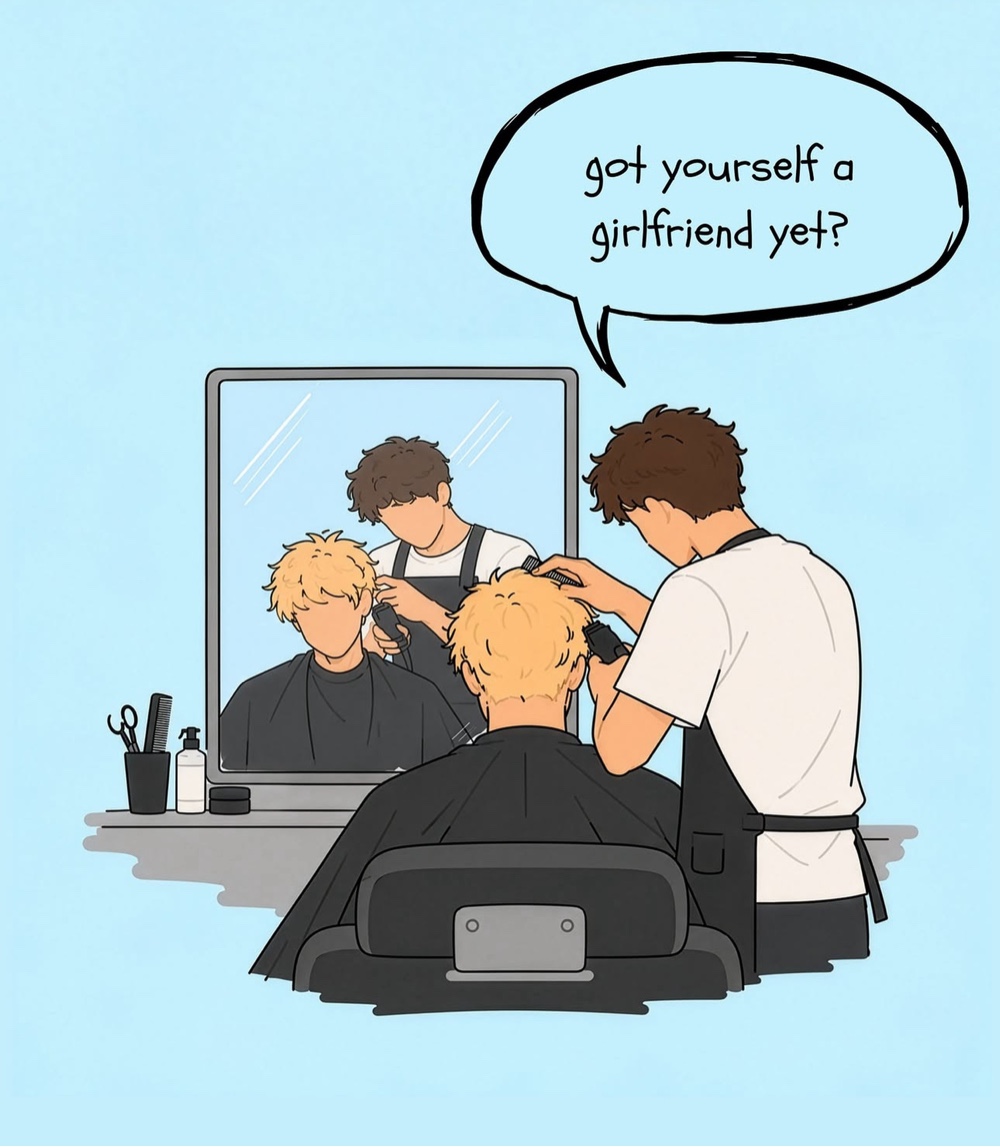
The questions simply change. Have you got a girlfriend? When are you going to settle down? When are you going to get married?

For heterosexual people, these may seem like harmless questions. For someone struggling with their sexuality, they can be painful reminders that the life others expect of them is not the life they are meant to live.

My friend, who is considerably younger than I am, told me something during our conversation that I found both beautiful and heartbreaking. He said he had reached a point in his life where he would choose to be gay again in every lifetime.

I wish I could have said that when I was his age.

For much of my life, I felt that I faced an impossible choice: keep my family or be myself. I could not have both. My family has never fully accepted me for who I am, and that rejection leaves wounds that do not simply disappear with time.

My friend’s words represent a freedom that I wish I had known much earlier in life. But I also recognize that we come to self-acceptance through different experiences, at different times, and sometimes through extraordinary pain.

I think this illustration captures something that is often misunderstood about the LGBTQ+ experience.

When someone says they would never have chosen to be gay, they are not necessarily saying that being gay is wrong. Sometimes they are saying that the suffering imposed upon them has been so great that they cannot imagine willingly choosing to endure it.

But we must be careful not to confuse the source of that suffering.

The problem is not the child who prefers playing with girls, the boy who loves fairy tales, or the young man who dreams of loving another man. The problem is a world that teaches them to be ashamed of those things.

There is nothing inherently shameful about being LGBTQ+. The shame comes from the judgments others impose upon us and the judgments we eventually learn to impose upon ourselves.

And unlearning those judgments can be one of the most difficult journeys we ever undertake.

The final illustration shows the young man kneeling beside his bed, his hands clasped in prayer.

I wonder how many LGBTQ+ Christians have knelt beside their beds and begged God to make them different. How many have prayed for their feelings to disappear, for their desires to change, or for the strength to become the person their families and churches expected them to be?

How many have interpreted God’s silence as evidence that they were unworthy of His love?

But what if we have been praying for the wrong kind of transformation?

What if God does not want us to become someone else? What if He wants us to learn to love the person He created?

Paul tells us that through the renewing of our minds, we “may discern what is the will of God—what is good and acceptable and perfect.”

For me, that renewal begins with recognizing that I can be both authentically gay and faithfully Christian. These are not competing identities. I do not have to choose between loving God and accepting myself.

But I also know that reaching that understanding is not as simple as deciding one morning to think differently.

For those of us who have spent years, sometimes decades, being told that something fundamental about us is wrong, learning to love ourselves can be extraordinarily difficult. The voices of condemnation do not simply disappear because we have decided to stop listening.

And I would never suggest that a change in attitude, a stronger faith, or a renewed commitment to God can magically solve every problem. The damage caused by years of rejection, shame, and fear can be profound. Depression, anxiety, and trauma are not signs of spiritual weakness, nor are they evidence that we have failed to trust God.

Sometimes healing requires therapy. Sometimes it requires medication. Sometimes it requires both, along with the love and support of people who accept us exactly as we are. There is no shame in seeking professional help, and doing so does not demonstrate a lack of faith.

Faith and medical treatment are not opposing forces. They can work together to help us become healthier, happier, and more fully ourselves.

The important thing is to begin.

Begin by questioning the voices that have told you that you are unworthy. Begin by recognizing that your identity is not something for which you must apologize. Begin by treating yourself with the same compassion you would offer someone else who was struggling. Begin by understanding that loving yourself is not selfish, and accepting yourself is not sinful.

Most importantly, begin by recognizing that you can be both authentically LGBTQ+ and faithfully Christian.

When we stop exhausting ourselves trying to satisfy everyone else’s expectations, we create room for something extraordinary. We begin to discover who we really are, what we believe, and how we can use the gifts God has given us.

And perhaps that is when we can begin to discern God’s will for our lives more clearly.

Perhaps our experiences of rejection will make us more compassionate toward others who suffer. Perhaps our struggles will give us the courage to stand against injustice. Perhaps the love we once believed we were unworthy of receiving will become the very love we offer to someone else who desperately needs it.

And perhaps, simply by living openly and faithfully, we can help another LGBTQ+ person understand that they, too, have a place in God’s kingdom.

I think about that little boy who was afraid to be seen playing with the girls at recess. I wish I could go back and tell him that there was nothing wrong with him. That he didn’t need to change the way he walked, talked, or held his hands. That he didn’t need to pretend to enjoy things he disliked simply to prove that he was masculine enough.

Most of all, I wish I could tell him that God loved him exactly as he was.

None of this means that life will suddenly become easy. There will still be people who reject us, churches that exclude us, and days when old insecurities return. Transformation is rarely a straight path, and healing does not mean that every wound disappears.

But we do not have to be perfect to begin living freely. We do not have to have all the answers before we can love ourselves. And we certainly do not have to become someone else to be worthy of God’s grace.

We can love ourselves, embrace who we are, and devote our hearts and spirits to God. These are not separate journeys, but parts of the same transformation.

And as our minds are renewed, we may discover that the freedom we have been searching for does not come from finally becoming what others wanted us to be. It comes from accepting who we have always been, recognizing God’s love within us, and allowing that love to shape the way we live.

For when we are no longer consumed by the struggle to deny ourselves, we are free to devote our energy to something far greater: loving God, loving our neighbors, and making a difference in a world that desperately needs more compassion, understanding, and grace.

God does not call us to conform to someone else’s idea of who we should be. He calls us to be transformed by His love, so that we can become more fully the people He created us to be.