There are certain sounds that immediately take me back to where I grew up in Alabama. I don’t mean music or voices or anything human-made. I mean the sounds of the natural world—the birds, the animals, and the nighttime chorus that filled the woods and riverbanks. For those of us who grew up in the South, these sounds are part of our memory in a way that never really leaves us.
My parents still live on a quiet cove along a river in Alabama. It’s the kind of place where wildlife is simply part of the landscape. You might not see everything that lives around you, but you certainly hear it. Southern nights have their own orchestra—owls hooting in the trees, frogs and insects humming in the darkness, and sometimes the distant bellow of an alligator rolling across the water.
One of the most unforgettable sounds is the call of the Great Horned Owl. It’s the classic owl sound—the deep “hoo-hoo” that carries through the woods at night. If you’ve ever heard it echo across water or through tall pines, you know how haunting it can be. They are large birds too. When you see one up close, standing upright on a branch, they can look enormous, almost prehistoric. My dad jokingly calls them “horny owls,” because of the tufts of feathers that stick up like horns from their heads.
If you answer their hoot with one of your own, sometimes they will fly closer to investigate. I have seen them land in nearby trees, curious about the stranger calling in their territory. It’s impressive, but also just unsettling enough to make you aware that you are not the only creature awake in the dark.
But the Great Horned Owl is not the only eerie sound of a Southern night. Screech owls live throughout the South, and their calls can be downright chilling. Despite the name, they often don’t screech at all. Instead, they make a trembling, haunting trill or a descending whinny that sounds almost ghostly in the darkness. When you’re lying awake in the woods and hear that sound drifting through the trees, it can raise the hair on the back of your neck.
Then there are the animals you rarely see but always hear. Alligators don’t usually come near my parents’ house, but farther down the river you can see them from a boat. Even when you can’t see them, you can sometimes hear them bellowing across the water at night. It’s a deep, vibrating sound that seems to roll through the darkness. If you’ve never heard it before, it can be a little unnerving. The South has a way of reminding you that nature is still very much alive around you.
Not all the sounds of the South are frightening. Some are simply part of the rhythm of the landscape.
One of my favorites is the whip-poor-will. People often hear its call exactly as its name suggests—“whip-poor-will.” When I was growing up, though, we had our own interpretation. To us it sounded like “Chip fell out of the white oak.” Once you hear it that way, it’s hard to hear anything else.
Then there is the bobwhite quail. Anyone who has spent time in southern fields knows that whistle. The male’s call really does sound like “Bob White!” It’s one of those bird calls that even people who don’t know birds can recognize immediately. The baby quail are especially adorable. You will sometimes see them walking along behind their mother in a neat little line, like a feathery parade moving through the grass. If they suddenly flush from a field, they burst up all at once, and for a moment they look like big brown bumblebees buzzing away across the field. They are surprisingly round birds when you see them take off like that.
Marshes and riverbanks bring another familiar voice: the red-winged blackbird. If you’ve ever camped near wetlands, you’ve probably heard its liquid, trilling call coming from the reeds. I first learned that sound while camping at Fort Pickens along the Gulf Coast, surrounded by marshes and coastal wildlife. Later I realized that the same birds show up far from the coast too. Occasionally I see them here in Vermont, which always feels like a little reminder of home.
Mockingbirds deserve a mention too. They are practically a symbol of Alabama, thanks to Harper Lee’s To Kill a Mockingbird. The birds themselves are famous for their ability to imitate other sounds, including other birds and sometimes even mechanical noises. I remember living in Mississippi and having a mockingbird outside my window that had learned to imitate a neighbor’s car alarm. It would sit in the crepe myrtle tree and loudly repeat that alarm sound in the early morning hours.
They are also fiercely protective parents. If you get too close to a mockingbird nest, they will often dive bomb you repeatedly until you move away from their chicks.
My grandfather used to say there was nothing wrong with killing a mockingbird because “they’re a damned nuisance!” Whether you find them charming or annoying, there’s no denying that they add their own unique voice to the Southern soundscape.
And of course there are the sounds that belong to both North and South. Ducks and geese honking across the water are just as familiar in Vermont as they are in Alabama. Their voices carry over ponds and rivers in a way that feels universal, part of the shared language of wetlands everywhere.
It’s funny how these sounds stay with us. Years later, you can hear a single call—a whip-poor-will at dusk, a bobwhite in a field, or the distant hoot of an owl—and suddenly you are transported back to a different place and time.
For those of us who grew up in the South, the landscape had its own language. The woods spoke at night, the marshes sang during the day, and the river carried voices across the water.
And once you learn that language, you never really forget it.
What about you? What wildlife sounds immediately take you back to where you grew up? I’d love to hear what voices from nature still echo in your memories.
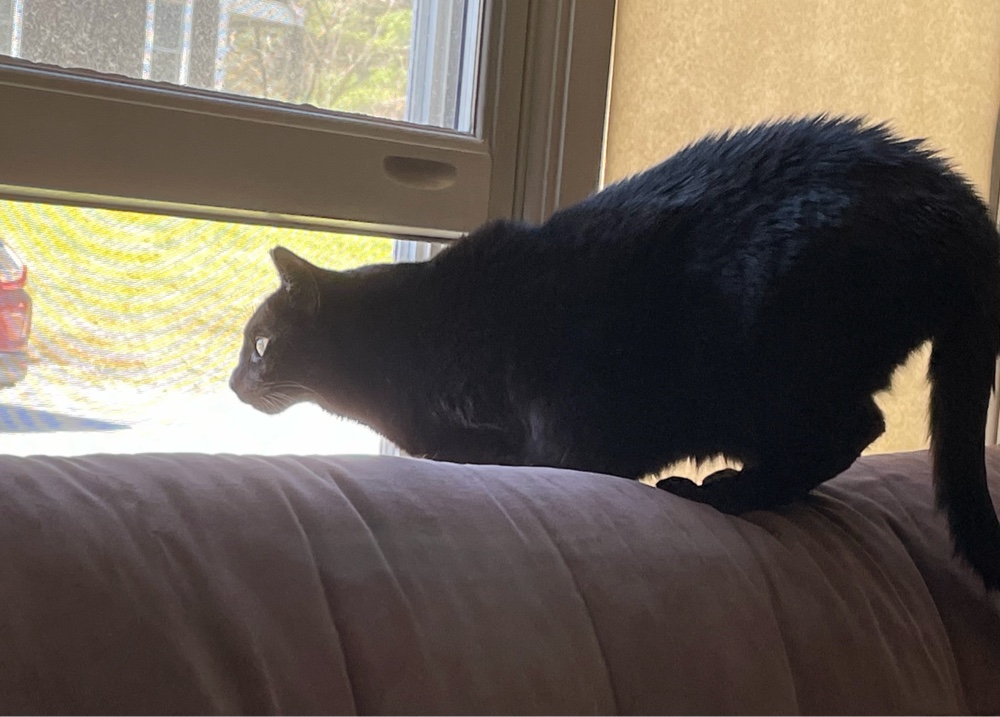
Isabella has her own favorite sound of nature—the robin. For some reason, robins fascinate her more than any other bird. When she sees one perched on the railing outside the window, she immediately runs over to watch it. Sometimes the two of them will simply stare at each other for several minutes, the robin calmly perched outside while Isabella crouches inside like a tiny black panther ready to pounce. Eventually the robin gets bored and flies away, which seems to irritate Isabella greatly, as if the hunt ended before it really began.

No comments:
Post a Comment