Showing posts with label Inspiration. Show all posts

Wednesday, August 26, 2026

I Will Always Love You, Dolly

🩷 Dolly Parton πŸ¦‹ 1946-2026 🩷

Yesterday, the world lost one of its brightest stars.

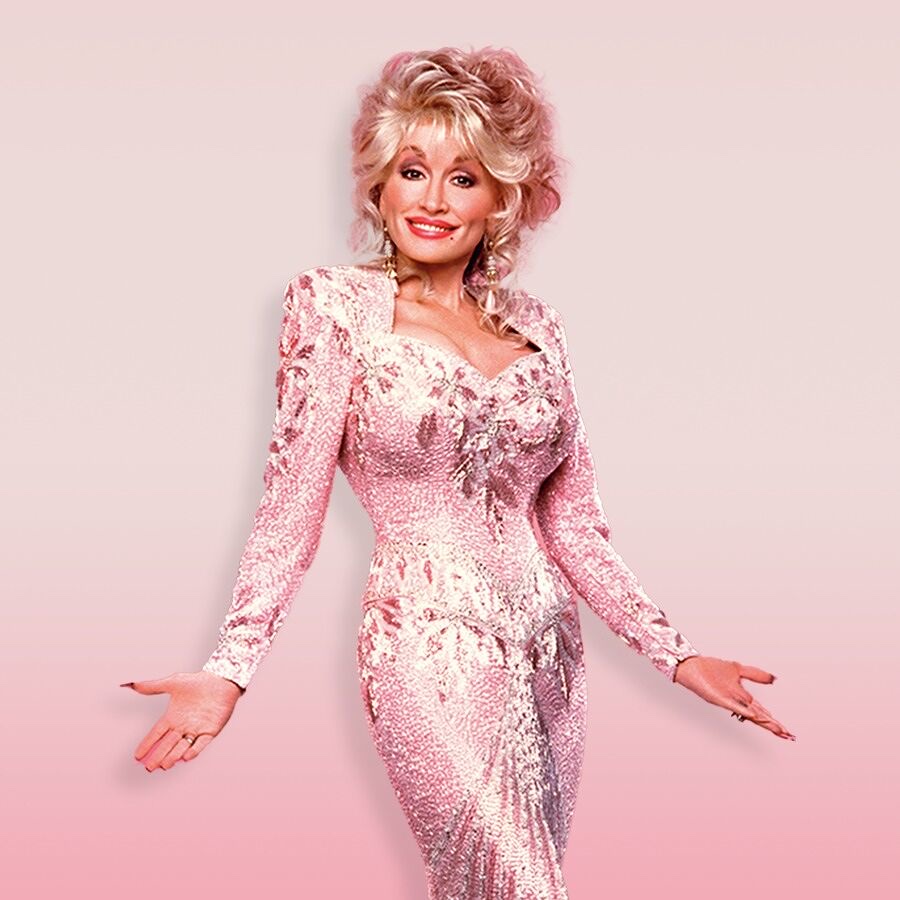
Dolly Parton died at the age of 80, and while there have been celebrity deaths that have saddened me over the years, this one has hit me particularly hard. I have cried a lot since hearing the news. It feels strange to grieve someone I never knew personally, but I suspect millions of people around the world are feeling much the same way.

Most people knew Dolly as a singer, songwriter, actress, and entertainer. She gave us “Jolene,” “Coat of Many Colors,” “9 to 5,” and, of course, “I Will Always Love You.” She was one of the greatest songwriters country music ever produced, with an unmistakable voice, an unmistakable appearance, and that wonderful laugh that I think I will always hear whenever I picture her.

But Dolly Parton was so much more than an entertainer.

She founded the Imagination Library in 1995 because her father could not read or write. What began as an effort to provide books to children in her home county in Tennessee grew into an international program that has given hundreds of millions of books to children. She gave money to families who lost their homes in the devastating 2016 wildfires in East Tennessee. She supported hospitals, education, disaster relief, and countless other causes. During the COVID-19 pandemic, her $1 million donation to Vanderbilt University Medical Center helped fund research that contributed to the development of the Moderna COVID-19 vaccine.

She didn’t just sing about making the world a better place. She put her money, her time, and her name behind actually doing it.

And now we know something that makes one of her final acts of generosity even more remarkable.

After Dolly’s death, it was revealed that she had been privately battling cancer. In January, to celebrate her 80th birthday, Dolly released a new version of “Light of a Clear Blue Morning,” joined by Lainey Wilson, Miley Cyrus, Queen Latifah, and Reba McEntire. The proceeds were designated for pediatric cancer research at Monroe Carell Jr. Children’s Hospital at Vanderbilt.

Dolly was fighting cancer herself, and she released a song to help children fighting cancer.

Someone writing about the song after her death put it perfectly: “Even while she was sick she was still thinking about others.”

That may be one of the best summaries of Dolly Parton I’ve heard.

Dolly promoted plenty of things during her long career. She was a brilliant entertainer and an equally brilliant businesswoman, and she certainly knew how to generate publicity. But some of the things that seemed to matter most to her—the things she did simply to help other people—were often done with surprisingly little fanfare.

Because the point wasn’t that Dolly Parton was helping.

The point was that someone needed help.

She didn’t announce that she was battling cancer when she released “Light of a Clear Blue Morning.” She didn’t make herself part of the story. She could easily have revealed her diagnosis and made the release about her own struggle with the disease. Instead, she directed the attention toward children with cancer and the doctors and researchers trying to save them.

Even at the end, when she had every reason to think about herself, Dolly was thinking about somebody else.

There is something almost unbearably beautiful about the song she chose, too. Dolly originally wrote “Light of a Clear Blue Morning” nearly fifty years ago as a song about emerging from darkness and believing that something brighter lies ahead. At 80 years old, while privately facing cancer, she returned to that message of hope—not to ask the world to hope for her, but to offer hope to others.

That was Dolly.

And for LGBTQ+ people, Dolly was something even more special.

Gay men have adored Dolly for generations. She knew it, joked about it, and embraced it. But underneath the rhinestones and jokes was something important: she embraced us.

Long before supporting LGBTQ+ people became commonplace among entertainers, Dolly made it clear that she wasn’t interested in judging people for whom they loved or who they were. After the horrific attack at Pulse nightclub in Orlando, she said something that, to me, sums up her attitude toward faith and other people better than almost anything else she ever said: “I am not God, I am no judge, I just know that God loves us all.”

Those are words a lot more Christians could stand to remember.

Dolly became one of our great heroes, one of our biggest divas, and one of the truest straight allies the LGBTQ+ community has ever had. I think part of the reason gay people loved her so fiercely was because Dolly understood something about being yourself in a world that constantly tells you how you’re supposed to be.

One of my favorite Dolly stories illustrates that perfectly. She used to tell about secretly entering a Dolly Parton look-alike contest at a gay club in Los Angeles. She exaggerated the Dolly look even further and entered alongside drag queens impersonating her.

And Dolly lost.

Nobody recognized that the real Dolly Parton was among them, and apparently the judges didn’t think Dolly made a particularly convincing Dolly. Instead of being offended, she thought the whole thing was hilarious. There is something wonderfully Dolly about losing a Dolly Parton look-alike contest to drag queens and turning it into one of your favorite stories to tell.

That sense of humor was such an important part of who she was. Dolly could laugh at herself endlessly, but I cannot remember ever hearing her publicly humiliate someone else for a laugh. She understood the difference between being funny and being cruel.

And nobody was more willing to make Dolly Parton the punchline than Dolly Parton.

She created an image that was deliberately over-the-top: the enormous blond wigs, the makeup, the rhinestones, the high heels, the famously exaggerated figure. She joked about all of it, usually at her own expense. She famously said that it cost a lot of money to look this cheap.

Yet underneath all that artifice was someone remarkably genuine.

Maybe that is one of the great lessons Dolly gave us. Authenticity doesn’t mean stripping away everything colorful or flamboyant about yourself. You can dress up. You can put on the wig. You can wear too much makeup and cover yourself in rhinestones. You can be outrageous and glamorous and larger than life—and still be completely, unapologetically yourself.

For someone whose public image was so carefully constructed, Dolly Parton may have been one of the most real celebrities we ever had.

And then there was Dolly’s faith.

Dolly grew up in the Church of God and spoke throughout her life about God, prayer, and the Christian faith that shaped her childhood. But as she grew older, her understanding of faith became broader and less tied to organized religion. In a 2024 interview, she even said, “I wouldn’t even say I’m religious, though I grew up with that background.” She spoke instead about a universal spiritual force that could be understood as God, Mother Nature, Father Time, or a higher wisdom.

And yet, for someone who hesitated to call herself religious, Dolly was one of the most Christ-like public figures I can think of.

She loved people. She accepted people. She gave generously. She helped those who were hurting. She encouraged children to learn. She treated people with dignity. And rather than appointing herself judge of people whose lives or beliefs differed from her own, she reminded us that God loves us all.

There are people who loudly proclaim their Christianity while devoting an extraordinary amount of energy to deciding whom God condemns. Dolly seemed far more interested in making sure people knew they were loved.

Perhaps Dolly’s faith didn’t fit neatly inside a particular religious box. I don’t think it needed to. When I think about Christ’s command to love our neighbors, care for those in need, and refrain from judging others, I can think of few people who lived those principles more publicly or more consistently than Dolly Parton.

She may not have called herself particularly religious.

But she certainly showed us what love looks like.

There is also one place where I know I will always think of Dolly. Anyone who has traveled I-65 into or out of Mobile, Alabama, probably knows the twin spans I’m talking about. I’ve never heard anyone call them anything but the “Dolly Parton Bridge”—or, more often, simply “the Dolly Partons.”

I’ve crossed the Dolly Partons hundreds of times in my life. They are one of those landmarks that have always just been there, part of the familiar landscape of home. The nickname is affectionate, a little irreverent, and very Alabama—and somehow Dolly seemed exactly the kind of person who could appreciate having a pair of bridges nicknamed for her cleavage.

Millions of people have crossed those bridges over the years, and millions more will cross them in the years to come. I suspect I’m not the only one who will think of Dolly when those great arches come into view.

I always have.

But from now on, I think I’ll smile a little differently when I see the Dolly Partons rising ahead of me. They’ll remind me of the wigs and rhinestones, the music, the generosity, that wonderful laugh, and most of all, the remarkable woman underneath it all.

Maybe that’s why this loss hurts as much as it does.

The world can feel increasingly cruel, angry, judgmental, and divided. Dolly somehow remained Dolly through all of it. She could walk into a room looking like she’d been dipped in a vat of rhinestones and still somehow make everything feel a little warmer.

She was funny without being cruel. She was glamorous without taking herself too seriously. She was enormously successful without forgetting people who had less. She had deeply held beliefs without needing to force them onto everyone else. And she understood that loving people was far more important than judging them.

She was truly one of a kind.

I know ending a remembrance of Dolly Parton with “I Will Always Love You” is probably the biggest clichΓ© imaginable. I’m sure those words have been repeated millions of times since the news broke.

But sometimes something becomes a clichΓ© because nothing else says it quite as well.

I will always love you, Dolly.

And somehow, despite the fact that you didn’t know most of us personally, I genuinely believe you loved us too. You certainly spent a lifetime showing us that you did.

Rest in peace, Dolly.

The world is a little less bright without you in it, but because of you, there will always be a light in the clear blue morning.



Friday, April 3, 2026

What Is Planted

There’s a particular stillness to Good Friday. Not the kind that feels peaceful, exactly—but the kind that feels held. Suspended. Waiting.

It’s the kind of quiet that lingers in your chest a little longer than usual, the kind that doesn’t rush you forward. It simply asks you to remain where you are.

Growing up, Good Friday meant something a little different in our house.

My father worked constantly—long hours for the telephone company, weekends included. Days off were rare, and even when he had them, they were usually filled with something that needed doing. But every year, without fail, he made sure he had Good Friday free.

That was the day he planted the garden.

It wasn’t arbitrary. It wasn’t just a convenient day off. It was something deeper than that—a quiet, inherited knowing.

In the South, Good Friday has long been considered the right time to plant. It’s that moment when winter has finally loosened its grip, when the ground is soft enough to receive what’s placed in it, when spring has arrived even if it hasn’t fully revealed itself yet. The air still carries a chill, but something underneath has already begun to change.

So while others marked the day in church pews or hushed reflection, my father marked it with his hands in the soil. And there’s something quietly profound about that. On a day that remembers death—he chose to plant something meant to live.

While the world recalls the crucifixion of Jesus Christ, he was participating in something older, something just as sacred: the trust that what is placed in the ground will rise again.

Good Friday is not a day of answers.

It doesn’t rush ahead to resurrection. It doesn’t skip past the hard part to get to joy. It lingers instead in that difficult, in-between space where loss is still real, where grief has not yet lifted, where hope exists but feels fragile—too small, too uncertain to fully grasp.

And maybe that’s why planting belongs here. Because planting is, at its core, an act of quiet faith.

You take something small—something that looks like almost nothing—and you place it into darkness. You cover it, knowing you won’t see it again for some time. And yet you do it anyway, not as an act of ending, but because you believe in what comes next.

For many of us—especially those of us who have had to carve out space for ourselves within faith—that rhythm feels deeply familiar.

There have been parts of ourselves we buried just to survive. Dreams we set aside because they weren’t safe to live out yet. Love we kept hidden, waiting for a place where it could breathe and grow.

And yet, even in those moments, something in us kept planting. Kept believing, however quietly, that what was placed in the ground was not gone.

Good Friday reminds us that not everything buried is lost. Some things are planted. Maybe that’s what my father understood, even if he never would have said it that way.

That this day, of all days, was the right time to trust the unseen. That the season itself was already turning. That the earth knew something was changing, even if nothing visible had broken through the surface yet.

So wherever you find yourself this Good Friday—in grief, in waiting, in uncertainty—hold onto this:

What is planted in love is never wasted.

Even in the dark.

Even in the silence.

Especially there.

At the end of this post, I’ve included “In Your Love” by Tyler Childers. It’s a story of love, loss, and the work that continues afterward—set against fields and soil much like the ones my father turned over each Good Friday. There’s something in it that echoes this day: the quiet persistence of love in the face of death, and the way life keeps moving forward, even when something—or someone—is gone.


Wednesday, December 24, 2025

Glitzen the Glitter-Nosed Reindeer


✨ Once upon a time, there was a reindeer who sparkled a little differently… 🌈✨


This is a fairy tale about joy that refuses to be dimmed, about glitter that outshines greed, and about choosing celebration when the world insists on silence. It’s a story for anyone who has ever been told to tone it down, stand in line, or make themselves smaller—and decided instead to shine.

Glitzen the Glitter-Nosed Reindeer is a tale of hope, courage, and unapologetic fabulousness. A reminder that being yourself is an act of bravery, that joy is powerful, and that light always finds a way back.


Pull up close.

The bells are ringing.

The glitter is flying.

And Christmas—real Christmas—is about to begin.


Glitzen the Glitter-Nosed Reindeer

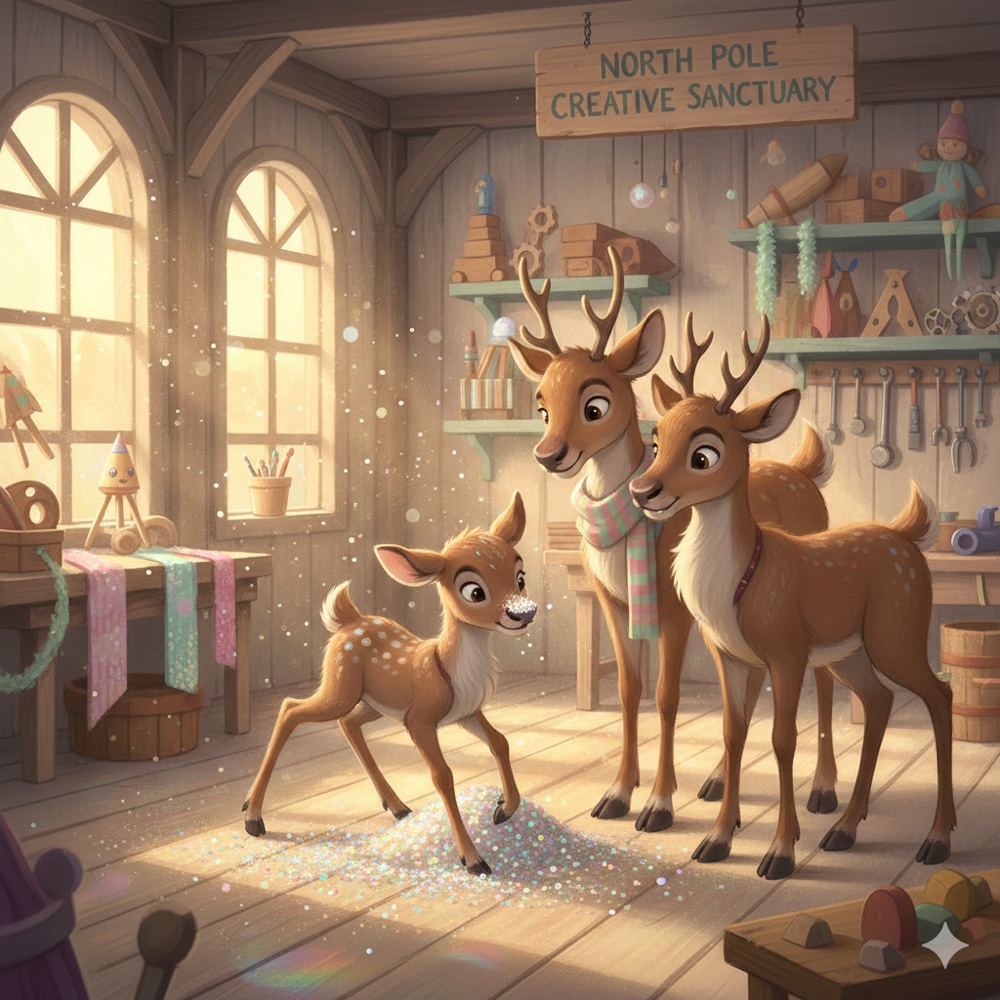
Early one May at the North Pole, one of Santa’s reindeer gave birth to a little reindeer. When the newborn stood for the first time, he promptly tipped forward—straight into a pile of glitter meant for Santa’s toy shop. Laughter rippled through the stable as the little fellow wobbled back onto his shaky legs, his nose completely covered in sparkle.

His mother smiled and decided then and there to name him Glitzen—a portmanteau of her father Blitzen’s name and the glitter he had tumbled into. As Glitzen grew, everyone noticed that his nose never stopped shimmering. It seemed he could never quite rid himself of that glitter from his very first encounter with the world.

The young buck reindeer laughed at him and called him names. Glitzen knew he was different. Instead of playing reindeer games with the other bucks, he preferred to prance and dance with the does. He felt far more comfortable in their company, and they never mocked him or made him feel small. Glitzen always seemed to know exactly how to make the does—and everything around them—more fabulous.

He had a natural instinct for fashion and decorating, an eye for sparkle and balance. The bucks wanted nothing to do with him. His parents loved him dearly, though his father was often a little embarrassed by his son. His mother, however, understood. She loved Glitzen’s confidence and admired how he remained true to himself, even when the other reindeer bullied him.

One year, the world beyond the North Pole grew especially dark.

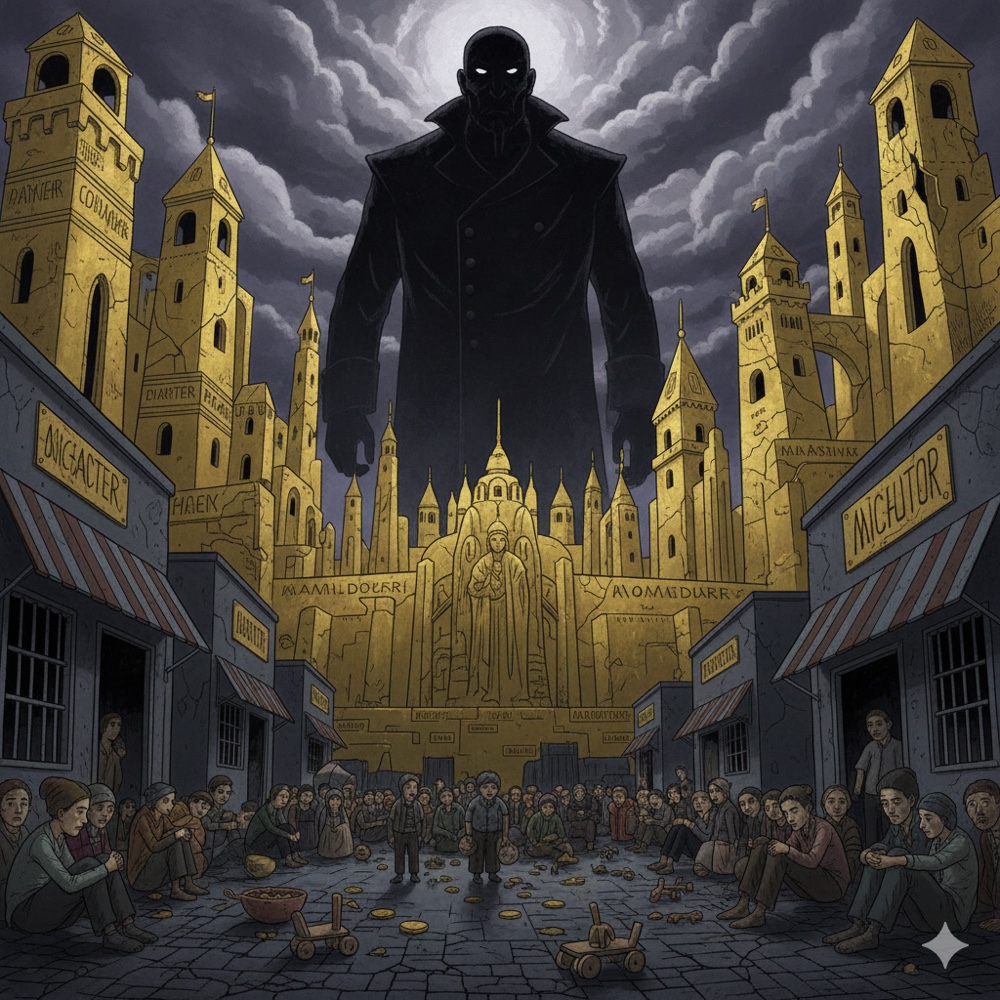
Across the Earth, a cruel and crooked dictator had risen to power. He ruled by fear, lies, and greed, demanding that the world worship him and his avarice above all else. He renamed cities, buildings, and institutions after himself, insisting his name be spoken everywhere, carved into stone and stamped in gold. Vast, glittering monstrosities were built in his honor—towering, hollow things—constructed by draining money, food, and comfort from ordinary people who could scarcely afford to lose any more.

Music was silenced. Color was discouraged. Celebration was mocked as weakness. People were told to fall in line, to stop dreaming, to stop being themselves. Hope, the dictator declared, was dangerous unless it served him.

And as the world grew heavier under his shadow, Santa’s Village felt it too.

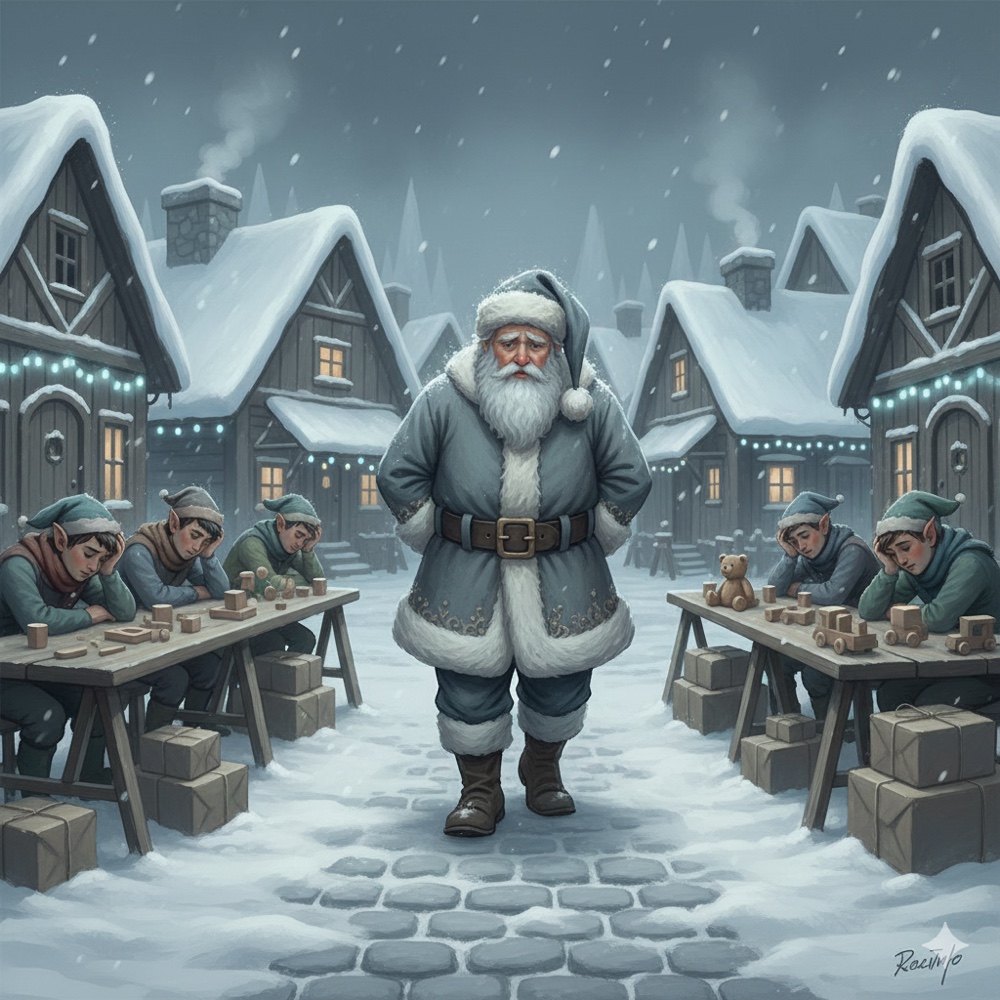
The elves lost their spark. Toys no longer shimmered. Wrapped packages looked dull and lifeless, as though joy itself had been taxed away and locked behind gilded gates. Santa was deeply troubled, but he understood—everything at the North Pole drew its energy from the world beyond. When the world was oppressed, the North Pole dimmed.

Santa himself felt blue, though he tried not to show it. Hoping to lift spirits and restore even a little cheer, he decided to walk through the Village.

As he wandered, Santa noticed the reindeer weren’t playing at all—just standing about with lowered heads. The elves worked without enthusiasm, and it showed in every toy they made. Then, suddenly, Santa heard laughter. Singing. Bells.

He stopped in his tracks.

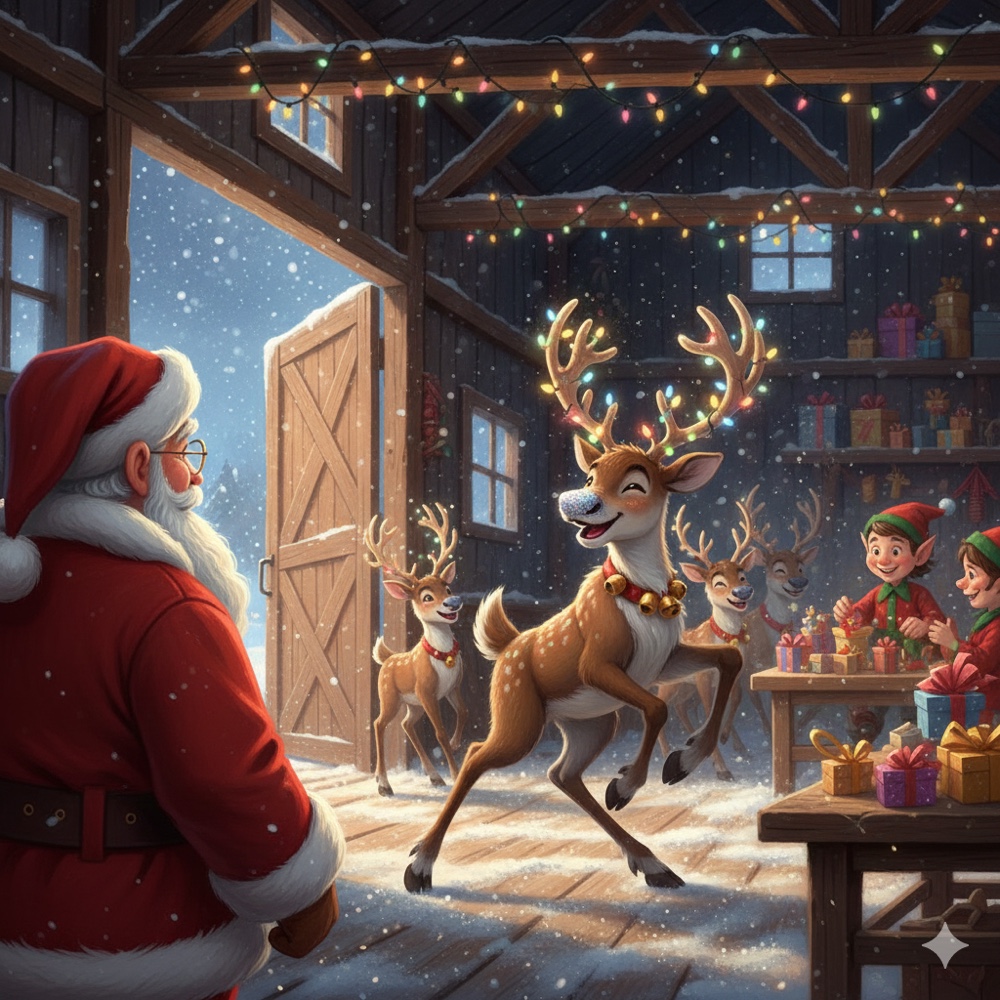
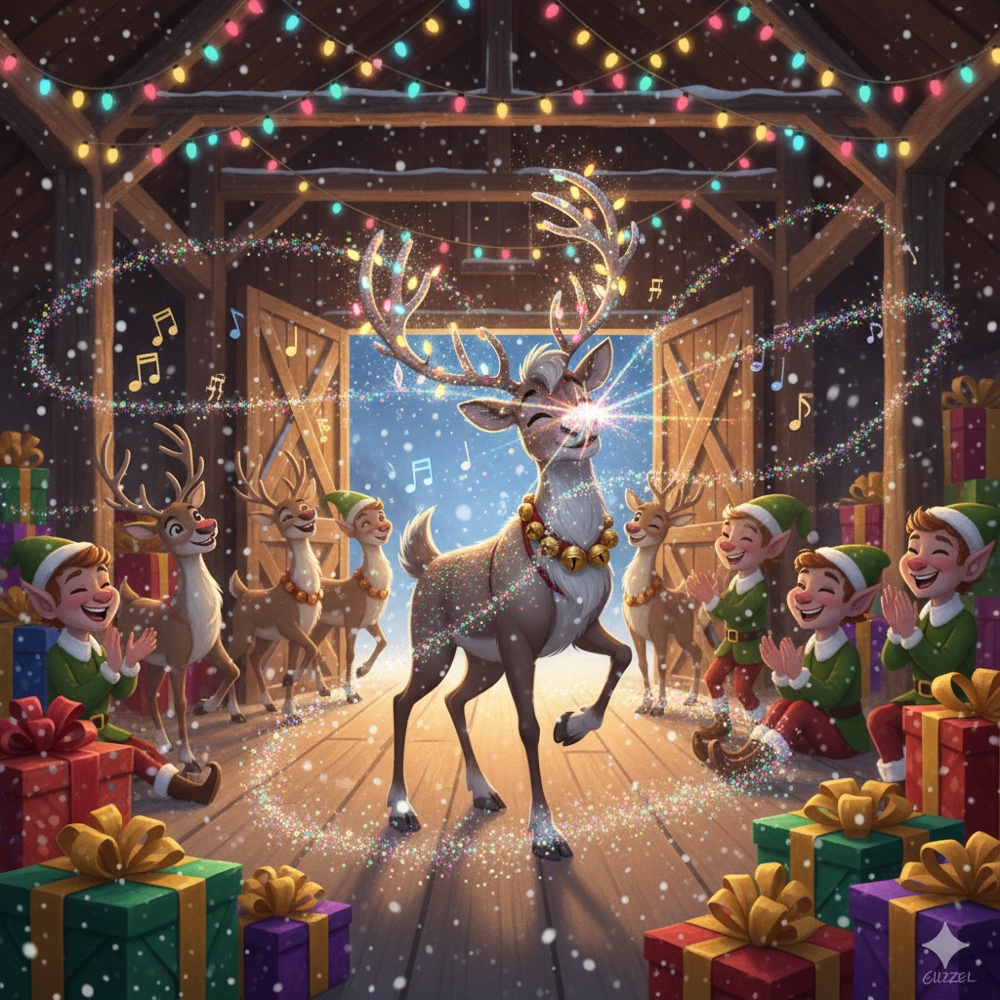
Following the sound, Santa entered the reindeer barn and was greeted by a truly fabulous sight. A group of young reindeer were dancing and singing, led by a buck with glitter on his nose and a string of lights woven through his antlers. Bells jingled as he moved, creating the most wondrous music, and everyone present was clearly delighted.

Laughing, Santa asked, “Everyone outside and in the toy shop is so gloomy—what happened in here to make things so festive?”

The reindeer laughed and pointed to Glitzen.

“Glitzen, my boy,” Santa said kindly, “how are you able to be so cheerful when the world feels so heavy?”

Glitzen looked up and replied,

“Santa, tyrants hate joy. They hate glitter. They hate people being themselves. They want us to worship their gold and their names instead of one another. But someone has to remind the world that they don’t get to take our light away. A little sparkle, some lights, and a few bells can help people remember who they are. I just wanted to remind everyone that we need a little Christmas right now.”

Then Glitzen began to sing:

Haul out the holly
Put up the tree before my spirit falls again
Fill up the stocking
I may be rushing things, but deck the halls again now.
For we need a little Christmas, right this very minute
Candles in the window, carols at the spinet
Yes, we need a little Christmas, right this very minute
Hasn't snowed a single flurry, but Santa dear we're in a hurry.

Santa joined in singing:

I need to climb down the chimney
Turn on the brightest string of lights I've ever seen
Slice up the fruit cake
It's time we've hung some tinsel on the evergreen bough.

Before anyone quite realized what was happening, the cheer inside the barn spilled out across the North Pole. Soon, everyone joined in:

For I've grown a little leaner, grown a little colder
Grown a little sadder, grown a little older
And I need a little angel sitting on my shoulder
Need a little Christmas now
For we need a little music, need a little laughter
Need a little singing ringing through the rafter
And we need a little snappy, happy ever after
We need a little Christmas now.

When the song finally faded, Santa smiled and said,

“Yes—we do need a little Christmas now. Glitzen, thank you for reminding us that joy is an act of courage. Now we need to share it with the world. Can you help me?”

“I’ll do anything I can, Santa,” Glitzen replied.

“First, help the elves and reindeer rediscover the Christmas spirit,” Santa said. “Then, on Christmas Eve, when I deliver presents, I need you to spread that spirit everywhere. Some people are frightened. Some are silenced. Some are told they must be less than who they are so others can feel powerful. But they need to know that joy, love, and glitter still belong to them. We can’t let cruelty win.”

Glitzen nodded eagerly. He and the does set to work at once, covering the Village in glitter and tinsel while singing Christmas songs. Soon, all the reindeer—including the bucks who had once teased him—joined in. The elves found their spark again. Toys gleamed, and the packages wrapped under Glitzen’s direction were among the most fabulous ever to leave the North Pole.

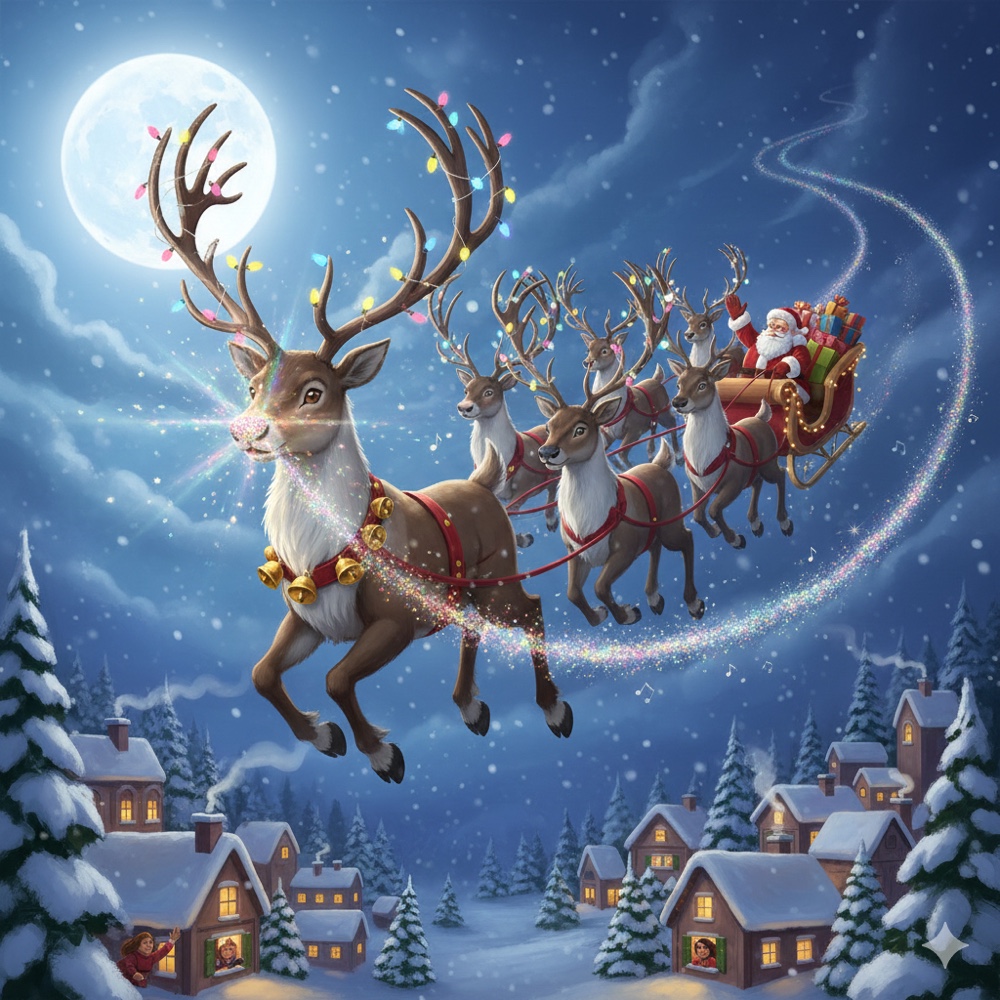
On Christmas Eve, Glitzen led Santa’s sleigh, flying proudly at the very front. As they soared across the world, glitter and light rained down upon cities and villages alike. And something remarkable happened.

As joy spread, fear loosened its grip. As people sang, the dictator’s lies rang hollow. The great golden monstrosities—symbols of greed and stolen comfort—began to crumble. Some were torn down by the people themselves. Others were melted, their gold redistributed to those who had been robbed of food, warmth, and dignity.

By morning, the dictator’s regime had collapsed. His name vanished from buildings and streets. His statues were gone. His power dissolved like frost in the sun.

People once again expressed themselves freely. Color returned. Music filled the air. Love was no longer hidden. And as a new year dawned, joy and happiness returned to the land.

The spirit of Christmas ruled the world again.

Santa and all the reindeer congratulated Glitzen—not only for being the most fabulous reindeer of all, but for reminding everyone that joy is powerful, truth is radiant, and glitter can change the world.

Merry Christmas, everyone!

May your holiday be fabulous—and if you wake up with a bit of glitter scattered about, perhaps Glitzen has visited your home this year.


Postscript

I know this is a silly story, and I first shared it several years ago. It was originally written during the gloom of Christmas 2020, when the pandemic swept across the world, creating isolation, fear, and deep sadness. That year, many of us felt cut off—from our families, our communities, and from joy itself.

But just as the pandemic eventually ended, we must believe that evil, too, will be crushed. Prosperity will be returned to the people. Cruelty will not have the final word.

This too shall pass.

In a time when LGBTQ+ identities are being crushed under the weight of fear and repression, when our glitter is mocked and our joy is treated as dangerous, we must remember Glitzen. Our fabulousness is not weakness—it is resistance. And when we let it shine, the world becomes brighter.

Christmas is proof that light returns.

Always.