 |
 |
 |
 |
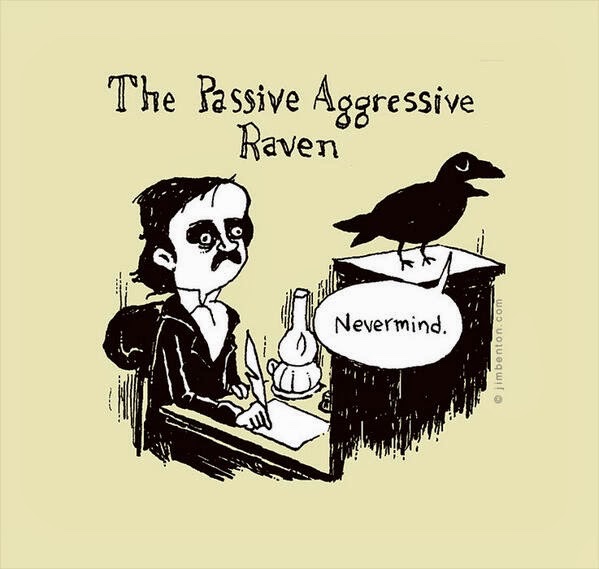
The Raven
By Edgar Allan Poe (1809–1849)
First published in 1845
Once upon a midnight dreary, while I pondered, weak and weary,
Over many a quaint and curious volume of forgotten lore—
While I nodded, nearly napping, suddenly there came a tapping,
As of some one gently rapping, rapping at my chamber door—
“’Tis some visitor,” I muttered, “tapping at my chamber door—
Only this and nothing more.”
Ah, distinctly I remember it was in the bleak December;
And each separate dying ember wrought its ghost upon the floor.
Eagerly I wished the morrow;—vainly I had sought to borrow
From my books surcease of sorrow—sorrow for the lost Lenore—
For the rare and radiant maiden whom the angels name Lenore—
Nameless here for evermore.
And the silken, sad, uncertain rustling of each purple curtain
Thrilled me—filled me with fantastic terrors never felt before;
So that now, to still the beating of my heart, I stood repeating,
“’Tis some visitor entreating entrance at my chamber door—
Some late visitor entreating entrance at my chamber door;—
This it is and nothing more.”
Presently my soul grew stronger; hesitating then no longer,
“Sir,” said I, “or Madam, truly your forgiveness I implore;
But the fact is I was napping, and so gently you came rapping,
And so faintly you came tapping, tapping at my chamber door,
That I scarce was sure I heard you”—here I opened wide the door;—
Darkness there and nothing more.
Deep into that darkness peering, long I stood there wondering, fearing,
Doubting, dreaming dreams no mortal ever dared to dream before;
But the silence was unbroken, and the stillness gave no token,
And the only word there spoken was the whispered word, “Lenore?”
This I whispered, and an echo murmured back the word, “Lenore!”—
Merely this and nothing more.
Back into the chamber turning, all my soul within me burning,
Soon again I heard a tapping somewhat louder than before.
“Surely,” said I, “surely that is something at my window lattice;
Let me see, then, what thereat is, and this mystery explore—
Let my heart be still a moment and this mystery explore;—
’Tis the wind and nothing more!”
Open here I flung the shutter, when, with many a flirt and flutter,
In there stepped a stately Raven of the saintly days of yore;
Not the least obeisance made he; not a minute stopped or stayed he;
But, with mien of lord or lady, perched above my chamber door—
Perched upon a bust of Pallas just above my chamber door—
Perched, and sat, and nothing more.
Then this ebony bird beguiling my sad fancy into smiling,
By the grave and stern decorum of the countenance it wore,
“Though thy crest be shorn and shaven, thou,” I said, “art sure no craven,
Ghastly grim and ancient Raven wandering from the Nightly shore—
Tell me what thy lordly name is on the Night’s Plutonian shore!”
Quoth the Raven “Nevermore.”
Much I marvelled this ungainly fowl to hear discourse so plainly,
Though its answer little meaning—little relevancy bore;
For we cannot help agreeing that no living human being
Ever yet was blest with seeing bird above his chamber door—
Bird or beast upon the sculptured bust above his chamber door,
With such name as “Nevermore.”
But the Raven, sitting lonely on the placid bust, spoke only
That one word, as if his soul in that one word he did outpour.
Nothing further then he uttered—not a feather then he fluttered—
Till I scarcely more than muttered “Other friends have flown before—
On the morrow he will leave me, as my hopes have flown before.”
Then the bird said “Nevermore.”
Startled at the stillness broken by reply so aptly spoken,
“Doubtless,” said I, “what it utters is its only stock and store
Caught from some unhappy master whom unmerciful Disaster
Followed fast and followed faster till his songs one burden bore—
Till the dirges of his Hope that melancholy burden bore
Of ‘Never—nevermore.’”
But the Raven still beguiling my sad fancy into smiling,
Straight I wheeled a cushioned seat in front of bird, and bust and door;
Then, upon the velvet sinking, I betook myself to linking
Fancy unto fancy, thinking what this ominous bird of yore—
What this grim, ungainly, ghastly, gaunt and ominous bird of yore
Meant in croaking “Nevermore.”
This I sat engaged in guessing, but no syllable expressing
To the fowl whose fiery eyes now burned into my bosom’s core;
This and more I sat divining, with my head at ease reclining
On the cushion’s velvet lining that the lamp-light gloated o’er,
But whose velvet violet lining with the lamp-light gloating o’er,
She shall press, ah, nevermore!
Then, methought, the air grew denser, perfumed from an unseen censer
Swung by Seraphim whose foot-falls tinkled on the tufted floor.
“Wretch,” I cried, “thy God hath lent thee—by these angels he hath sent thee
Respite—respite and nepenthe, from thy memories of Lenore;
Quaff, oh quaff this kind nepenthe and forget this lost Lenore!”
Quoth the Raven “Nevermore.”
“Prophet!” said I, “thing of evil!—prophet still, if bird or devil!—
Whether Tempter sent, or whether tempest tossed thee here ashore,
Desolate yet all undaunted, on this desert land enchanted—
On this home by Horror haunted—tell me truly, I implore—
Is there—is there balm in Gilead?—tell me—tell me, I implore!”
Quoth the Raven “Nevermore.”
“Prophet!” said I, “thing of evil—prophet still, if bird or devil!
By that Heaven that bends above us—by that God we both adore—
Tell this soul with sorrow laden if, within the distant Aidenn,
It shall clasp a sainted maiden whom the angels name Lenore—
Clasp a rare and radiant maiden whom the angels name Lenore.”
Quoth the Raven “Nevermore.”
“Be that word our sign in parting, bird or fiend!” I shrieked, upstarting—
“Get thee back into the tempest and the Night’s Plutonian shore!
Leave no black plume as a token of that lie thy soul hath spoken!
Leave my loneliness unbroken!—quit the bust above my door!
Take thy beak from out my heart, and take thy form from off my door!”
Quoth the Raven “Nevermore.”
And the Raven, never flitting, still is sitting, still is sitting
On the pallid bust of Pallas just above my chamber door;
And his eyes have all the seeming of a demon’s that is dreaming,
And the lamp-light o’er him streaming throws his shadow on the floor;
And my soul from out that shadow that lies floating on the floor
Shall be lifted—nevermore!
About the Poem
With Halloween just a few days away, I could hardly resist choosing one of my favorite poems, Edgar Allan Poe’s “The Raven.” Of course, I love nearly all of Poe’s poetry. There is something hauntingly beautiful about his writing, the way he can take grief, loneliness, fear, and longing and transform them into something almost musical. His poetry is dark, certainly, but it is also extraordinarily beautiful.
Whenever I read “The Raven,” I always hear it in the unmistakable voice of Vincent Price. Price made a famous recording of the poem, and I suspect many people of my generation remember a teacher pulling that record from its sleeve, carefully placing it on the classroom record player, and lowering the needle. Then came that wonderfully theatrical voice, deep, resonant, and just sinister enough to send a chill down your spine. Price had a remarkable ability to make even the simplest words sound deliciously ominous, and his reading of “The Raven” was unforgettable. I can still hear him uttering “Quoth the Raven ‘Nevermore’” with just the right mixture of melancholy and menace. For me, Poe’s poetry and Vincent Price’s voice will forever be connected.
Incidentally, I came across the job posting for Curator of Educational Programs at the Vincent Price Art Museum in Los Angeles just this morning. As much as I admire Vincent Price and love the idea of working at a museum bearing his name, I have absolutely no desire to live in Los Angeles. Still, I couldn’t help smiling at the coincidence.
What I find most compelling about “The Raven” is that, beneath its Gothic atmosphere and supernatural suggestions, it is really a poem about grief. The raven itself may be nothing more than an ordinary bird that has learned a single word, but the narrator gives that word increasingly terrible meaning. He asks questions to which he desperately wants comforting answers, even as he seems to know what the raven will say. His torment comes not necessarily from the bird, but from his own inability to escape his sorrow.
Perhaps that is what makes the poem so frightening. There is no monster lurking in the darkness, no ghost rising from the grave, and no murderer waiting behind the door. Instead, the horror comes from within, from the memories and regrets that haunt us long after someone we love is gone. The raven becomes a symbol of a grief that refuses to leave, and its repeated “Nevermore” is the terrible finality of loss.
And yet, even with all its sorrow, I find “The Raven” magnificent. Poe’s language, rhythm, and imagery make it a poem that demands to be read aloud, preferably on a dark and stormy night. If you can manage to hear Vincent Price narrating it, so much the better.
First published on January 29, 1845, in the New York Evening Mirror, “The Raven” became an immediate sensation and established Edgar Allan Poe as one of America’s most recognizable literary figures. Its popularity was extraordinary, and readers were captivated by its hypnotic rhythm, intricate rhymes, and mysterious atmosphere.
The poem follows an unnamed narrator mourning the death of his beloved Lenore. Alone in his chamber on a bleak December night, he hears a tapping at his door and then at his window. When he opens the shutter, a raven enters and settles upon a bust of Pallas Athena, the Greek goddess of wisdom. The bird speaks only one word, “Nevermore,” but the narrator gradually interprets that word as a series of increasingly devastating answers to his questions about grief, hope, and the possibility of reunion with Lenore in the afterlife.
Poe was a master of poetic sound. “The Raven” employs trochaic octameter, internal rhyme, alliteration, and repetition to create its distinctive, almost hypnotic musicality. The recurring “Nevermore” serves as a refrain, becoming more ominous with each appearance. What begins as a curious encounter gradually develops into a psychological nightmare.
In his 1846 essay “The Philosophy of Composition,” Poe described his approach to writing “The Raven,” explaining his deliberate choices of subject, atmosphere, and poetic structure. He argued that the death of a beautiful woman was among the most melancholy subjects in poetry and that a raven, with its dark appearance and capacity to imitate human speech, was an ideal messenger for the poem’s refrain.
The raven’s perch upon the bust of Pallas Athena is also significant. Athena represents wisdom and reason, yet the narrator increasingly abandons rational thought as his grief overwhelms him. The bird’s position above the door suggests an inescapable presence, while its final shadow becomes a powerful symbol of the narrator’s despair.
Although “The Raven” is frequently associated with Halloween, its enduring appeal goes far beyond its Gothic imagery. It explores the universal human experience of mourning and the painful realization that some losses cannot be undone.
About the Poet
Edgar Allan Poe (January 19, 1809 – October 7, 1849) was an American poet, short-story writer, literary critic, and editor whose work helped shape Gothic literature, psychological horror, and the modern detective story. His influence extends far beyond American literature into film, music, and popular culture.
Born in Boston, Massachusetts, Poe experienced tragedy early in life. His father abandoned the family, and his mother died when he was only two years old. He was taken in by John and Frances Allan of Richmond, Virginia, though he was never formally adopted. His relationship with John Allan was often strained, particularly over financial matters.
Poe attended the University of Virginia briefly and later enlisted in the United States Army. He also entered the United States Military Academy at West Point but was dismissed in 1831. He eventually pursued a career in writing and editing, working for several literary publications while struggling with financial insecurity.
In 1836, Poe married his cousin Virginia Clemm, who was thirteen at the time. Their marriage lasted until her death from tuberculosis in 1847. Virginia’s illness and death profoundly affected Poe, and themes of lost love, mortality, and mourning appear repeatedly throughout his poetry and fiction.
Among his best-known poems are “Annabel Lee,” “The Bells,” “Ulalume,” and “A Dream Within a Dream.” His short stories, including “The Tell-Tale Heart,” “The Fall of the House of Usher,” “The Black Cat,” and “The Masque of the Red Death,” remain classics of Gothic horror. His 1841 story “The Murders in the Rue Morgue” is widely regarded as a foundational work of modern detective fiction.
Poe died in Baltimore on October 7, 1849, at the age of forty. The circumstances surrounding his death remain uncertain, adding one final mystery to a life that has become almost as legendary as his writing.
Although Poe struggled to achieve financial stability during his lifetime, his literary legacy has proved extraordinary. His ability to explore the darkest corners of the human imagination while maintaining a remarkable sense of beauty and musicality continues to captivate readers nearly two centuries later.
Perhaps that is why Poe remains such a perfect poet for Halloween. His writing reminds us that the most haunting things are not always the supernatural horrors that lurk in the shadows, but the very human emotions that remain with us long after the darkness has passed.
And as the raven would remind us, some things stay with us forevermore.
 |
It’s Monday morning, and we’ve reached the last week of October. I’ll pretty much have the museum to myself today, except for a few meetings with professors and the classes I’ll be teaching. There’s plenty to keep me busy, but I can worry about all of that later. Right now, I’m going to enjoy my coffee, watch the news, and ease into the morning before getting ready for work. There’s no need to rush into Monday any faster than necessary.
Have a great day, everyone!
 |
“Take delight in the LORD, and he will give you the desires of your heart.”
— Psalm 37:4
We all have desires that we carry deep within our hearts. We long for love, companionship, healing, happiness, and peace. We ask God to ease our burdens, mend our broken hearts, and guide us toward a better life. Sometimes our prayers are answered in ways that seem almost miraculous. Other times, we pray for months or even years, only to find that nothing changes. When that happens, we may begin to wonder whether God is listening. After all, Psalm 37:4 tells us that if we delight ourselves in the Lord, God will give us the desires of our hearts. So why do so many of our prayers seem to go unanswered?
Perhaps the answer lies in understanding what it truly means to delight ourselves in the Lord. This verse is not a promise that God will grant our every wish. Faith is not a transaction in which we offer God our devotion in exchange for the things we want. Rather, delighting in the Lord means finding joy in God’s presence, trusting in God’s love, and allowing that love to shape the way we live. Sometimes the desires we believe will bring us happiness are not the desires that will ultimately bring us peace. Sometimes what we ask God to change is something God never intended us to change at all.
Love, too, is never transactional. Love is not something we earn by meeting someone else’s conditions, nor is it something that should be withdrawn when we fail to satisfy another person’s expectations. Yet many of us are told that if we are LGBTQ+, our families will withdraw their love. We may hear that we will no longer be welcome, that we have disappointed the people who raised us, or that we must change before we can be accepted again. Those messages can wound us deeply, especially when they come from the people whose love we have trusted most.
But that is not how love works. Love does not say, “I will love you if you become someone else.” Love does not make belonging dependent upon conformity. Love does not demand that we deny our identity, hide our relationships, or surrender the truth of who we are in order to remain worthy of care. When affection is offered only as a reward for obedience, it becomes conditional approval, not the self-giving love God calls us to embody.
For many LGBTQ+ Christians, this is an especially painful truth. I suspect that nearly every gay Christian who grew up believing homosexuality was sinful has, at some point, prayed not to be gay. We prayed to be straight, to be “normal,” to become the people our families, churches, and communities expected us to be. Some of us begged God night after night to take away our attraction to the same sex. We promised to be better Christians, to pray harder, to live more faithfully, if only God would grant us that one request. We believed that if we could change, we might finally be worthy of God’s love and acceptance.
But those prayers went unanswered.
For years, many of us interpreted that silence as a failure on our part. Perhaps we weren’t praying hard enough. Perhaps our faith wasn’t strong enough. Perhaps God was testing us, or worse, perhaps God had turned away from us. We carried shame and guilt for something we could not change, convinced that our inability to become straight meant we were somehow disappointing God.
Some of us also feared that our families would stop loving us if we told the truth about who we were. We may have believed that love could be taken away as punishment for being LGBTQ+. We may have tried to earn acceptance by hiding, apologizing, or promising to change. But our identity was never a moral failure, and our families’ love should never have been made conditional upon our ability to conform. We were not asking to be granted permission to exist. We were asking to be loved as the people we already were.
But what if we misunderstood God’s answer all along? What if God wasn’t refusing to listen, but was instead refusing to make us into someone we were never meant to be? What if the very thing we begged God to take away was part of the person God had lovingly created?
Psalm 139:14 reminds us, “I praise you, for I am fearfully and wonderfully made.” Those words are not reserved for heterosexual Christians. They belong to all of God’s children. We are not mistakes that need correcting. We are not defective creations waiting to be repaired. We are human beings created in God’s image, capable of extraordinary love, compassion, kindness, and faith. Our sexuality does not diminish our worth in God’s eyes, nor does it place us beyond the reach of God’s grace.
When we begin to accept that truth, our understanding of unanswered prayers can change. Perhaps God did not make us straight because becoming someone we are not would never have brought us the joy we imagined. It might have satisfied the expectations of others, but at what cost to our own hearts and souls? A life spent denying who we are, hiding our capacity for love, and constantly fearing that God disapproves of us is hardly the abundant life Jesus spoke of in John 10:10.
That does not mean accepting ourselves guarantees a life of happiness without hardship. Living openly and authentically can bring rejection, discrimination, loneliness, and heartbreak. Some LGBTQ+ Christians lose the support of their families or the churches they once called home. Others struggle for years to overcome the shame they were taught to feel. Yet there is a profound difference between suffering because the world refuses to accept us and suffering because we have been taught to refuse to accept ourselves. We cannot always control how others treat us, but we can learn to stop believing that their condemnation speaks for God.
And when families withdraw their support, we should be honest about what has happened: the failure is not in the LGBTQ+ person who told the truth. The failure is in the belief that love can be used as leverage. A parent may feel confused, afraid, or unprepared, but those feelings do not justify withholding love. Family love should not be a prize awarded for heterosexuality, gender conformity, or religious agreement. It should be a commitment to remain present, to listen, to learn, and to honor the person who has always been part of the family.
Jesus taught that the greatest commandments are to love God with all our hearts and to love our neighbors as ourselves (Matthew 22:37–39). Notice that Jesus did not tell us to love only those who look like us, believe exactly as we do, or conform to society’s expectations. Jesus commanded us to love. And that love includes recognizing our own worth as children of God. If we cannot see ourselves as worthy of love, how can we fully embrace the love God offers us or share it freely with others?
Love of neighbor also means refusing to make another person’s belonging conditional. We cannot claim to love someone while demanding that they erase themselves to remain welcome. We cannot tell LGBTQ+ people that they are loved and then withdraw family, community, or spiritual support when they live honestly. Love may require patience, growth, and difficult conversations, but it does not require rejection. Love can be truthful without being cruel, and it can hold convictions without withholding compassion.
Delighting ourselves in the Lord means more than attending church, reading Scripture, or saying our prayers. It means allowing God’s love to transform our hearts and guide our actions. It means showing compassion instead of judgment, offering kindness instead of condemnation, and recognizing the dignity of every human being. It means living a Christian life defined not by fear of punishment or the expectation of rewards, but by love itself.
And perhaps, as we grow in faith, the desires of our hearts begin to change. Instead of praying, “God, please make me someone else,” we may come to say, “God, help me become the person You created me to be.” Instead of begging God to take away our capacity to love, we may ask for the courage to love more deeply, more generously, and more faithfully. Instead of seeking the approval of those who condemn us, we may find peace in knowing that God’s grace has never depended upon their acceptance.
We may also begin to recognize the difference between love and approval. Not everyone will understand us, and not everyone will affirm our choices or identity. But no one has the right to make our basic worth dependent upon their approval. God’s love is not a contract that can be canceled when we disappoint someone. It is not a reward for performing correctly. It is a gift that reveals our worth before we have done anything to earn it.
Of course, unanswered prayers are not limited to our struggles with sexuality. We pray for loved ones who are ill, for relationships that have ended, for financial burdens to be lifted, and for suffering to cease. Sometimes the healing never comes, the relationship is never restored, or the circumstances never improve. We may never understand why. Faith does not require us to pretend that disappointment doesn’t hurt or that every tragedy is somehow a blessing in disguise. We can grieve, question, and even cry out to God in frustration while continuing to trust in God’s love.
When family relationships are broken, we may grieve the love we hoped to receive. We may mourn the parent, sibling, or relative who chose rejection over relationship. That grief is real, and we do not have to minimize it by pretending that everything is fine. At the same time, we can remember that another person’s refusal to love us well does not prove that we are unlovable. Sometimes the family we need is the family we find: friends, partners, affirming congregations, mentors, and communities that welcome us without demanding that we disappear.
Ultimately, our Christian hope extends beyond the circumstances of this earthly life. The greatest promise God has given us is not that we will receive everything we desire here on earth, but that through God’s grace we may share in eternal life with God. Revelation 21:4 offers a beautiful vision of that promise: “God will wipe every tear from their eyes. Death will be no more; mourning and crying and pain will be no more, for the former things have passed away.”
What a glorious promise that is. A day when there will be no more rejection, no more shame, no more loneliness, and no more suffering. A day when we will no longer question whether we are worthy of God’s love because we will dwell forever in its fullness.
But we need not wait until heaven to begin experiencing the joy of that love. We can find it here, in the kindness we show others, in the relationships we nurture, in the compassion we extend to those who are hurting, and in the freedom of living truthfully as the people God created us to be. We can practice a love that does not keep score, demand repayment, or disappear when someone becomes difficult to understand. We can create families and communities where belonging is not conditional and where every person is treated as a beloved child of God.
Perhaps that is one of the greatest lessons of Psalm 37:4. God does not always give us what we ask for, and we may never understand every unanswered prayer. But when we delight ourselves in the Lord, when we open our hearts to God’s grace and allow God’s love to guide our lives, we may discover that some of the things we once begged God to change were never wrong in the first place.
We may spend years asking God to make us different, only to discover that the answer we needed was God’s invitation to love and accept the person we have always been. We may spend years fearing that our families will withdraw their love, only to learn that love worthy of the name does not depend upon our conformity. And as we journey through this imperfect world, loving God and loving one another, we can rest in the promise that the greatest joy of all still awaits us: an eternity in the presence of the One whose love has never failed us.
May we carry that love into the world. May we reject the shame and fear that tell people they must become someone else to be worthy of God’s grace. May we refuse to use love as a reward or belonging as a bargaining tool. May we honor the dignity of every person, welcome those who have been pushed aside, and help create families and communities where LGBTQ+ people can live truthfully, love faithfully, and know that they belong. And when we face unanswered prayers, may we remember that silence is not proof of abandonment, that rejection is not proof of unworthiness, and that our worth has never depended on becoming anyone other than the person God created us to be.
 |
Years ago, when I was in graduate school and living in Mississippi, I remember stopping at a CVS and spotting a shirtless guy sitting on a motorcycle across the street. I’ve never been particularly interested in motorcycles, but damn, that man had a body that could stop traffic! He was perched on what we used to call a “crotch rocket,” a sleek, racing-style motorcycle that has the rider leaning forward over the handlebars. Now, I know riding without a helmet or protective clothing is dangerous, but at that moment, motorcycle safety was not exactly what was on my mind. Let’s just say that while his crotch rocket was parked, he had my motor purring—and the rocket in my own crotch was more than ready for liftoff! It’s been probably twenty years, and I still remember that glorious sight. Apparently, some things have a way of staying in your head long after they’ve left your rearview mirror.
 |
 |
 |
 |
 |
 |
 |
 |
 |
 |
Have you ever woken up from a dream and thought, “Damn, that only happens in porn!”? I had one of those dreams last night, and while it was wild and deliciously indecent, I certainly seemed to be having a good time. I won’t go into the details because, quite frankly, they’re a little much for a public blog post. Let’s just say my subconscious apparently has quite the dirty little imagination.
At least I slept well, and I’m ready for the day. Thank goodness it’s Friday! I’m more than ready for the weekend. After having only a one-day weekend last week, I could really use two full days of rest and relaxation.
Tomorrow is going to be a football day. I have games I want to watch beginning at noon, another at 3:30 p.m., and the last one starting at 5 p.m. I think this might be the first Saturday this season when all three of my teams are playing at different times, though the afternoon games may overlap a little. Every other weekend, either one of my teams had a bye week or two of them were playing at the same time. It’ll be nice to watch all three without having to constantly switch back and forth between games.
With the weather getting colder here in Vermont, I’m also planning to make a pot of Zuppa Toscana. I might even try a new recipe I came across the other day for Spinach Artichoke Chicken. Since I’ll already be buying kale for the soup, I’m thinking of substituting kale for the spinach in the chicken recipe. I’ve always preferred kale to spinach anyway. I think it’s a texture thing.
That’s probably the same reason I prefer collard greens to turnip greens. When I make a pot of greens, I almost always use collards. My mother used to say that turnip greens were slimy, though I don’t think that’s quite the right word. Boiled okra is slimy. Turnip greens just cook down to a much softer texture, almost like spinach, whereas collards hold their texture a little better. I suppose I just prefer greens with a little more substance to them.
And somehow, I’ve gone from talking about a particularly indecent dream to discussing the texture of leafy green vegetables. That’s quite a transition, even for me!
Anyway, I think that’s enough rambling for one post. It’s shaping up to be an f-ing good weekend! Have a great Friday and a wonderful weekend, everyone!