 |
Thursday, April 30, 2026

I Am Not I
 |
I Am Not I
by Juan Ramón Jiménez
I am not I.
I am this one
walking beside me whom I do not see,
whom at times I manage to visit,
and whom at other times I forget;
the one who remains silent when I talk,
the one who forgives, sweet, when I hate,
the one who takes a walk where I am not,
the one who will remain standing when I die.
Today is Poem in Your Pocket Day, a celebration that encourages people to carry a poem with them—literally in a pocket, a wallet, or on a phone—and share it with others throughout the day. It’s a simple idea, but a powerful one: that poetry is not meant to sit quietly on a shelf, but to travel with us, to meet us where we are, and perhaps to say something we didn’t know we needed to hear.
When I started thinking about what poem I wanted to carry today, I realized I wanted something about finding oneself. Not in the grand, dramatic sense, but in the quieter, more honest way that happens over time—through reflection, contradiction, and those moments when we catch a glimpse of who we really are.
That’s what led me to this poem.
Jiménez writes of a self that is both present and just out of reach—a companion we walk beside but do not fully know. It’s a haunting idea, but also a comforting one. There is a part of us that is patient, that forgives, that waits for us to catch up to it. A self that is perhaps truer than the one we show to the world.
I think many of us, especially those of us who have had to navigate questions of identity, faith, or belonging, know this feeling well. There is the self we’ve been told to be, the self we’ve tried to be, and somewhere alongside us, the self we are becoming.
Poetry has a way of naming that space.
If I were to carry a poem in my pocket today, it would be this one—not because it gives me answers, but because it reminds me that the search itself is part of the journey. That perhaps finding oneself is not about arriving somewhere new, but about recognizing the one who has been walking beside us all along.
About the Poem
“I Am Not I” is a brief but deeply philosophical meditation on identity. In just a few lines, Jiménez presents the self as divided—one part visible and active, the other quiet, observant, and enduring.
The poem resists a fixed definition of identity. Instead, it suggests that who we are is layered:
- the outward self that speaks and acts
- the inward self that watches, forgives, and persists
The final line—“the one who will remain standing when I die”—adds a spiritual dimension, hinting at a self that transcends the physical or temporal. Whether read psychologically, philosophically, or spiritually, the poem invites us to consider that our truest self may not always be the one we immediately recognize.
Its brevity is part of its power. Like the best “pocket poems,” it can be read in a moment but linger in the mind far longer.
About the Poet
Juan Ramón Jiménez (1881–1958) was a Spanish poet and one of the most important literary figures of the 20th century. He was awarded the Nobel Prize in Literature in 1956 for his lyrical poetry, which is known for its clarity, emotional depth, and pursuit of what he called “pure poetry.”
Jiménez’s work often explores themes of beauty, memory, and the inner life. His writing evolved over time from richly ornamented early poems to a more stripped-down, essential style—seeking precision and truth in language.
He is perhaps best known for Platero y yo, a poetic prose work beloved for its tenderness and reflection on life and loss. Though widely read, especially in the Spanish-speaking world, many of his shorter lyrical poems—like “I Am Not I”—continue to resonate for their quiet insight into the human experience.
What poem would you carry in your pocket today?
Sleeping In
 |
Wednesday, April 29, 2026

Borrowed Sunlight
 |
Vermont might be known as the Green Mountain State, but it often feels like the Gray Sky State. Most people I know take Vitamin D because the sun can be such a rare guest. The past few days, though, have been a welcome exception—bright, clear, and almost generous with their light. Of course, today’s sunshine is apparently our last for a while. Rain is moving in tonight and tomorrow, which we do need. It’s been so dry that wildfires have already started to pop up, something that always feels a bit out of place here.
Still, I’m glad to wake up feeling better this morning and able to appreciate the sunlight, even if I’ll spend most of it inside the museum. It figures that the day I’m free to be out and about, the clouds will roll back in and bring the rain with them. That seems to be the way of things—sun when you’re busy, rain when you’re not.
I suppose that just makes days like today feel a little more precious.
Tuesday, April 28, 2026

No Poem
 |
Not quite myself this morning. I woke up feeling off and hoped breakfast might help—it didn’t. If anything, it made the nausea worse, so I went back to bed for a bit.
Now it’s time to get up and face the day. I do have things that need to get done at work, though if I don’t start feeling better, it may end up being a short one.
No poem today.
Monday, April 27, 2026

Montreal
 |
I had a fantastic time in Montreal—truly one of those trips that leaves you feeling both refreshed and a little wistful when it’s over.
As I always do, I spent some time in the Village, which never disappoints, but I made sure this trip wasn’t only about nightlife. One of my favorite stops was the Montreal Museum of Fine Arts, where I saw The Torlonia Collection, a remarkable exhibition of Roman sculpture.
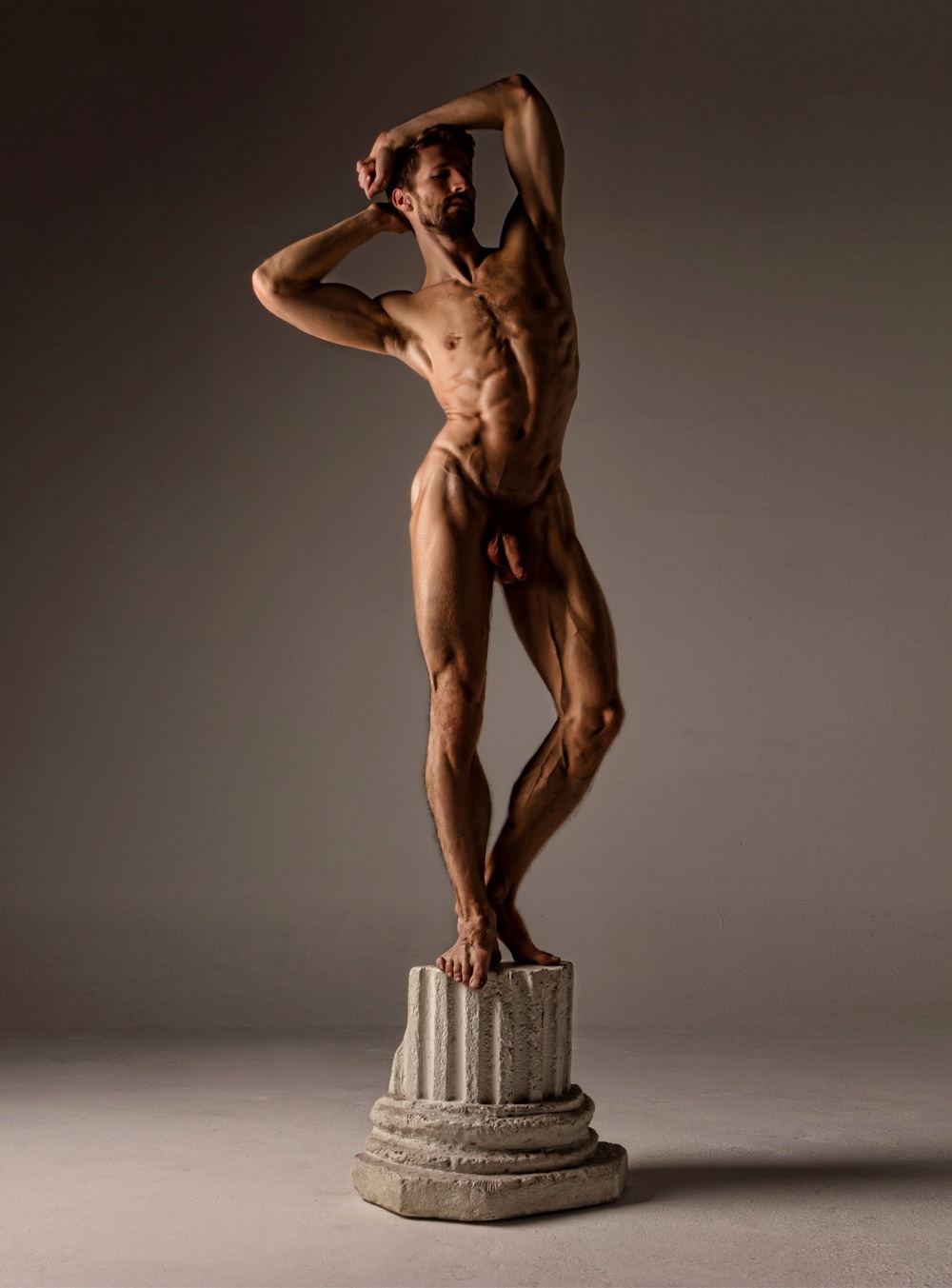
Of all art forms, sculpture has always been the one that speaks to me most, and this exhibit did not disappoint. What fascinated me most was not just the ancient works themselves, but the visible history layered onto them. Many of the sculptures had been damaged over time—arms missing, hands broken, features worn away—and then “repaired” during the Renaissance.
These restorations were not neutral. Renaissance artists interpreted what should have been there, and in doing so, they left their own mark on antiquity. One statue in particular stood out: an athlete whose original form had lost several parts, including an arm, a hand, and his penis. When these were restored, the additions reflected Renaissance ideals more than Roman ones—especially the rather substantial size of the newly added anatomy.
That detail might sound amusing, but it actually reveals something deeper about cultural values. In ancient Greco-Roman art, the ideal male nude was typically depicted with relatively modest proportions. A large penis was often associated with foolishness or lack of restraint, not heroic virtue. Bodies were idealized after gods—balanced, controlled, harmonious.
By contrast, the Renaissance reinterpretation leaned into a different aesthetic, and the difference was striking—especially when this restored athlete stood beside an intact Roman sculpture. The contrast was immediate and, honestly, a bit jarring once you understood the symbolism behind it.
It was also a reminder of how art is never entirely fixed. Even ancient works continue to be shaped—physically and intellectually—by the cultures that encounter them later.
I’ve visited the museum before, but this exhibition made the trip especially worthwhile. If you ever have the chance to see it, I highly recommend it.
I also stopped by a temporary exhibit on M. C. Escher near Place des Arts. His work is endlessly fascinating—those impossible staircases and mind-bending tessellations never really lose their charm.
That said, I found myself less impressed with the exhibit itself than with the art. The lighting felt off in several areas, and the layout didn’t always serve the pieces as well as it could have. It’s funny—I don’t think I would have noticed these things as much before working in a museum. Once you’ve been involved in installing exhibits yourself, you start to see all the little decisions that shape how visitors experience a space… and when those decisions don’t quite land.
Beyond the museums, I did a little shopping, wandered the city, and simply enjoyed being somewhere that feels vibrant and alive. Montreal has a way of offering just enough of everything—art, culture, nightlife, and quiet moments when you need them.
All in all, it was a wonderful trip. I just hope it won’t be another seven years before I make it back—and next time, I’d like to stay a bit longer than three nights.

Sunday, April 26, 2026
Greatly Beloved Were You to Me
 |
“When David had finished speaking to Saul, the soul of Jonathan was bound to the soul of David, and Jonathan loved him as his own soul.”
—1 Samuel 18:1
There are certain images that stay with us—not just as works of art, but as moments of recognition.
For me, David by Michelangelo has always been one of those images.
I still remember the first time I saw him in person in Florence. I had just arrived, and visiting the Galleria dell’Accademia was one of the very first things I did. I walked into that long gallery, and there he was—at the end, illuminated, larger than life. I remember looking up with a kind of awe that felt both artistic and deeply personal. It wasn’t just the mastery of the sculpture—it was presence. Humanity carved into stone.
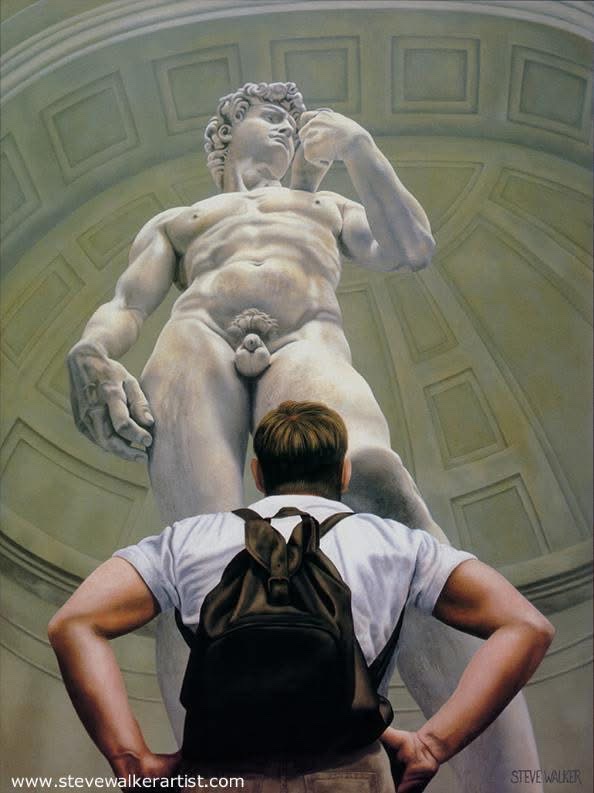
When I first started this blog, I chose David and Me by Steve Walker as my avatar. It reminded me of myself the first time I stood before David—looking up, searching, captivated. Back then, I even physically resembled the figure in Walker’s painting. I’m older now. It has been over twenty years since I last visited Florence, and I’ve changed in ways I could not have imagined then.
But the awe remains.
And because of that fascination with David, I have always found myself drawn not only to the figure in marble, but to the story in scripture—to the love between David and Jonathan.
“Then Jonathan made a covenant with David, because he loved him as his own soul.”—1 Samuel 18:3
From the very beginning, their relationship is described in language that is intimate, binding, and profound. Their souls are knit together. Their love is named openly. A covenant is made—not out of obligation, but out of love.
“Jonathan made David swear again by his love for him; for he loved him as he loved his own life.”—1 Samuel 20:17
This is not casual affection. This is not distant loyalty. This is a love that insists on being spoken, reaffirmed, and held fast even in the face of danger.
“They kissed each other, and wept with each other; David wept the more.”—1 Samuel 20:41
There is tenderness here. Physical closeness. Emotional vulnerability. Grief shared without restraint.
And then, in the end, there is lament.
“I am distressed for you, my brother Jonathan; greatly beloved were you to me; your love to me was wonderful, passing the love of women.”—2 Samuel 1:26
Few passages in scripture speak of love with such intensity. So what are we to make of it? Was this admiration? A deep and abiding friendship?
Was it something like the bond between Achilles and Patroclus, or between Alexander the Great and Hephaestion—relationships that have long existed in that space between friendship and something more?
Or could it have been a love that was intimate in ways the text does not fully define, but does not deny?
The truth is, we will never know with certainty.
But we can pay attention to the language. The Hebrew does not shy away from words of love, of binding, of covenant. It does not diminish their connection. And yet, across centuries, translations and interpretations have often been shaped by the assumptions and discomforts of those doing the translating.
Some render the relationship in ways that feel safer—contained, strictly platonic. Others allow the emotional depth to remain, even if they stop short of naming it outright.
Which raises a different question: not only what was their relationship, but what are we willing to see in it?
For many LGBTQ+ people of faith, this story resonates deeply.
We know what it is to form bonds that others do not understand. We know what it is to love in ways that are questioned, reinterpreted, or denied.We know what it is to hear our stories explained away.
And yet, here in scripture, the love between David and Jonathan is not erased. It is spoken. It is remembered. It is grieved.
I think about that when I think of David—both the young man of scripture and the figure carved in marble.
Strength and beauty, yes. But also vulnerability. Connection. Love that dares to speak its name, even in a world that may not fully understand it.
Maybe we don’t need to resolve the question of what, exactly, David and Jonathan were to each other. Maybe it is enough to let their story remain open—to allow it to hold possibility.
Because for those of us who have been told that our love has no place in sacred story, even the possibility matters.
Even the words themselves are enough:
Greatly beloved were you to me.
Saturday, April 25, 2026








Friday, April 24, 2026

Ah, Montreal…
 |
The drive up to Montreal was a pleasant one. Even the Canadian border guard was nice—unexpectedly so (and, I have to admit, very easy on the eyes). In all the times I’ve made this trip, I’ve always found it a bit odd that the Canadian guards tend to be the stern ones while the Americans are usually more relaxed. I suppose I’ll find out on the return trip whether that still holds true. One can hope for consistency… or at least a repeat of yesterday’s good fortune.
But enough about border crossings.
It felt wonderful last night to wander through the Village again and to be reminded what it’s like to be in a real city—energy, movement, people everywhere. It’s something I don’t get nearly enough of, and I’ve missed it more than I realized.
My hotel room also came with an unexpected gift: a beautiful view of the St. Lawrence River. There’s something calming about watching the water, especially in the early morning light.
And speaking of morning—I actually slept in. That alone feels like a luxury, and it’s why this post is a bit later than usual.
Now, it’s time for a proper start to the day: breakfast, a good cup of coffee, and then out to explore more of Montreal.
Thursday, April 23, 2026
At Last
 |
Finally, the day has come. I’m leaving for four days in Montreal.
It’s been too long—since 2019—and I’ve missed the city more than I realized. This trip feels like a long-overdue chance to step away, relax, and just enjoy myself for a few days. I’m looking forward to wandering through a few museums, doing a little shopping, and spending some time in The Village. From what I’ve seen, it’s changed a bit since the pandemic, but I’m still excited to revisit some of my favorite spots, maybe check out a few bars, and just have some fun.
More than anything, though, I’m looking forward to something simple: being a visitor.
For once, I won’t be thinking about programming, planning events, or representing the museum. I won’t be teaching, guiding, or organizing anything. I’ll just be another person walking through galleries, taking things in at my own pace, enjoying the experience without responsibility.
That alone feels like a vacation.
The weather is supposed to be sunny and cool—exactly the kind of weather I love—so everything seems perfectly timed. After a busy stretch of work, I’m ready for a few days to breathe, explore, and recharge.
Montreal, here I come.
Wednesday, April 22, 2026

Playing Host
 |
Yesterday was one of those full, nonstop days that reminds me just how much I can pack into a schedule when I need to. Our speaker arrived, and from about 7:30 in the morning until 9:00 last night, I was on the go—playing host, coordinating details, showing off a bit of Vermont, and making sure everything went smoothly. Aside from a brief hour at home between getting her settled into the hotel and heading out to dinner, it was constant motion.
Thankfully, Isabella took a little pity on me this morning and let me sleep until 5:00—though she made it quite clear that she did not approve of the delayed breakfast. Even with the extra rest, I’m feeling the wear of it today, and I know I’ll be just as tired when I finally get home tonight.
Still, this is one of my favorite parts of what I do. There’s something genuinely rewarding about hosting our out-of-town speakers—getting to know them, sharing a glimpse of Vermont, and helping create a welcoming experience. She’s been wonderful to spend time with, and I’ve truly enjoyed it.
But I’ll admit, I’ll also be glad when I drop her off at the airport this evening. Tomorrow, I check into my own hotel, and for the first time in a few days, I’ll be able to pause, breathe, and relax a bit. And right now, that sounds pretty perfect.
Tuesday, April 21, 2026
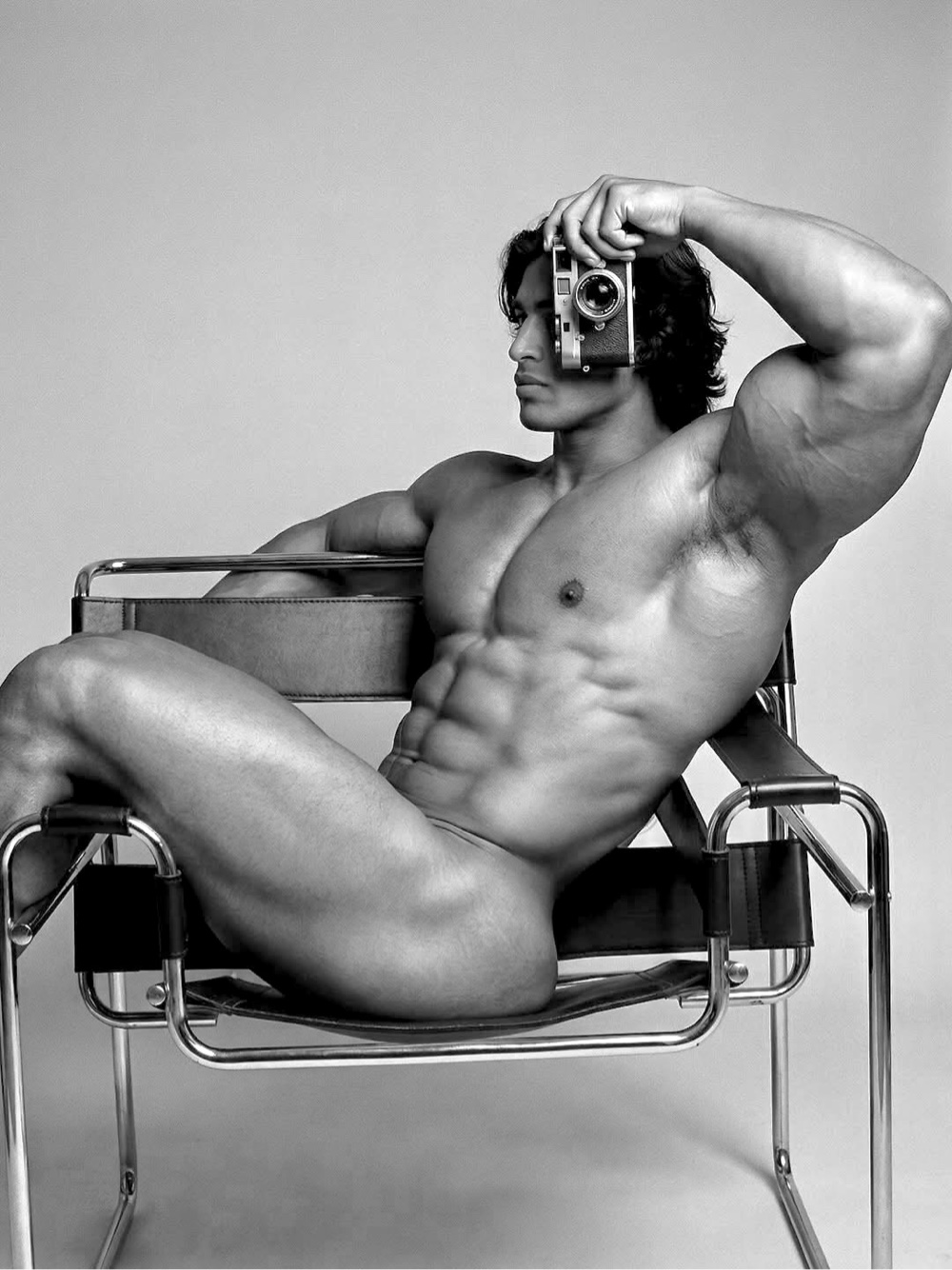
The Hug
 |
The Hug
By Thom Gunn
It was your birthday, we had drunk and dined
Half of the night with our old friend
Who’d showed us in the end
To a bed I reached in one drunk stride.
Already I lay snug,
And drowsy with the wine dozed on one side.
I dozed, I slept. My sleep broke on a hug,
Suddenly, from behind,
In which the full lengths of our bodies pressed:
Your instep to my heel,
My shoulder-blades against your chest.
It was not sex, but I could feel
The whole strength of your body set,
Or braced, to mine,
And locking me to you
As if we were still twenty-two
When our grand passion had not yet
Become familial.
My quick sleep had deleted all
Of intervening time and place.
I only knew
The stay of your secure firm dry embrace.
About the Poem
Last night I had a dream about the guy I had a crush on in high school. In the dream, he had brought his son to visit my university because the kid wanted to attend a military academy that would accept him for being gay. My old crush had not known I worked there and was on an admissions tour that included a short visit to the museum. I happened to be walking through the museum when I saw him and immediately recognized him. I’ve changed a lot since high school but he barely had. I called his name and he turned around. At first he didn’t recognize me and I told him who I was. He was so happy to see me that he hugged me. That’s when I woke up. I woke up very aroused and it took me a bit to fall back asleep, but even though it was not an erotic dream, being in his arms was enough to arouse me. Anyway, it made me remember Thom Gunn’s poem “The Hug” even though the narrative of the poem is nothing like my dream.
What Gunn captures so beautifully here—and what my dream unexpectedly echoed—is the quiet power of physical closeness that exists outside of overt sexuality. The poem insists, almost defensively, “It was not sex,” and yet the intimacy it describes is unmistakably charged. The body remembers what the mind might try to categorize differently. A simple embrace becomes a kind of time machine, collapsing years into a single moment of contact.
That’s what struck me most when I woke up: not desire in any explicit sense, but the memory of being held—of being known physically, instinctively, without explanation. Gunn’s speaker experiences the same phenomenon. Sleep erases “intervening time and place,” and in that suspended moment, the past returns not as memory but as sensation. The body pressed against another body becomes a language of its own, one that speaks of history, affection, and perhaps even a love that has changed shape but not disappeared.
There’s something profoundly human—and quietly queer—about that. So often, queer intimacy has had to exist in these in-between spaces, where touch carries meanings that words cannot safely express. A hug becomes not just comfort, but recognition. Not just familiarity, but longing. Not just presence, but history.
And maybe that’s why the poem lingers. It reminds us that intimacy isn’t always loud or dramatic. Sometimes, it’s as simple—and as overwhelming—as waking up in someone’s arms.
One of the most striking tensions in “The Hug” lies in the line, “It was not sex, but…” Why does Gunn feel the need to make that distinction—and what does it reveal about the nature of intimacy in the poem?
On the surface, the poem draws a boundary between physical affection and sexual activity. However, everything that follows that line complicates the distinction. The speaker is acutely aware of the other man’s body: its strength, its positioning, the way it “locks” them together. The embrace is described in deeply physical, almost sensual terms, suggesting that the experience exists on a spectrum rather than within a strict category.
This raises an important question: is Gunn diminishing the eroticism of the moment, or is he expanding our understanding of what intimacy can be? The hug becomes a space where emotional history, bodily memory, and desire converge—without needing to resolve into explicit sexuality. In doing so, the poem challenges the reader to reconsider the boundaries we place on physical connection.
Ultimately, “The Hug” suggests that intimacy is not defined solely by sexual acts, but by presence, memory, and the profound recognition of another body against one’s own.
About the Poet
Thom Gunn (1929–2004) was an Anglo-American poet known for his precise language, formal control, and evolving thematic interests. Born in England, he later moved to the United States, where he became associated with the San Francisco literary scene.
Gunn’s early work was often formal and restrained, but over time, his poetry grew more experimental and personal, particularly as he began to write more openly about gay life and relationships. His work frequently explores themes of identity, physicality, desire, and the tension between control and freedom.
In later collections, especially those written during the AIDS crisis, Gunn’s poetry took on a deeply emotional and elegiac tone, reflecting both personal loss and broader communal grief. “The Hug,” while quieter and more intimate than some of his other works, reflects his enduring interest in the body—not just as a site of desire, but as a vessel of memory, connection, and meaning.
Subscribe to:
Posts (Atom)