 |
“Do not be conformed to this world, but be transformed by the renewing of your minds, so that you may discern what is the will of God—what is good and acceptable and perfect.”
— Romans 12:2
For many LGBTQ+ Christians, these words from the Apostle Paul carry a particularly powerful meaning. We have spent so much of our lives trying to conform to what others believe we should be. We have been told how to act, how to dress, whom to love, and even how to worship God. We have been told how to hold our hands so they aren’t too expressive, how to walk without that telltale swish in our steps, how to sit properly, and how to change our voices to sound deeper and more masculine. We have been taught to watch every gesture, every word, and every movement, lest we reveal something about ourselves that others might find unacceptable.
We have been taught that acceptance, both from the world and sometimes even from our own families and churches, depends upon our willingness to deny some essential part of ourselves. Too often, we have believed those voices, even when doing so has caused us tremendous pain. There is a particular kind of suffering that comes from trying to squeeze ourselves into a mold that was never made for us. We twist ourselves into impossible shapes, suppress our feelings, question our worth, and convince ourselves that if we could just be different, we might finally be worthy of love.
When I was in graduate school, I read Passing, a novel by Nella Larsen, a Black woman who was part of the Harlem Renaissance. Published in 1929, the novel explores the lives of two Black women, one of whom conceals her racial identity and lives as white, even from her own husband. The novel examines the complicated relationship between identity, belonging, and the sacrifices people make to gain acceptance in a society that judges them for who they are. Although Larsen was writing about racial passing in a deeply segregated America, I found myself identifying with the emotional struggle of hiding one’s true identity.
For generations, LGBTQ+ people have been taught to do our own kind of passing. We have pretended to be straight, suppressed our mannerisms, concealed our relationships, and sometimes even married people we could never truly love, all in the hope of being accepted by our families, our communities, and our churches. We have been told that if we could just pass as heterosexual Christians, we would somehow become better Christians. The historical experiences of racial passing and concealing one’s sexuality are not the same, but both can reveal the terrible emotional cost of being forced to hide who we are. The fault lies not with those who conceal their identities for safety or acceptance, but with the prejudice that makes such concealment necessary.
I was reminded of this recently during a conversation with a good friend who sent me a series of illustrations depicting the experiences of a young gay man growing up in a world that continually told him he needed to be someone else. The first illustration, which I’ve used at the beginning of this post, asks a question that many LGBTQ+ people have probably asked themselves at some point: “I’m sorry, who would choose this?”
My immediate response to my friend was that God knows I would never have chosen to be gay. Not because I believe there is anything wrong with being gay, but because I know the pain, loneliness, fear, and rejection that have accompanied it throughout much of my life. If I could have spared that frightened little boy the suffering he would endure, I would have wanted to.
But perhaps we have been asking the wrong question all along. Instead of asking why anyone would choose to be gay, perhaps we should ask why the world makes being gay so difficult that anyone would wish to be someone else.
The illustrations that follow tell that story, and in many ways, they tell my story as well.
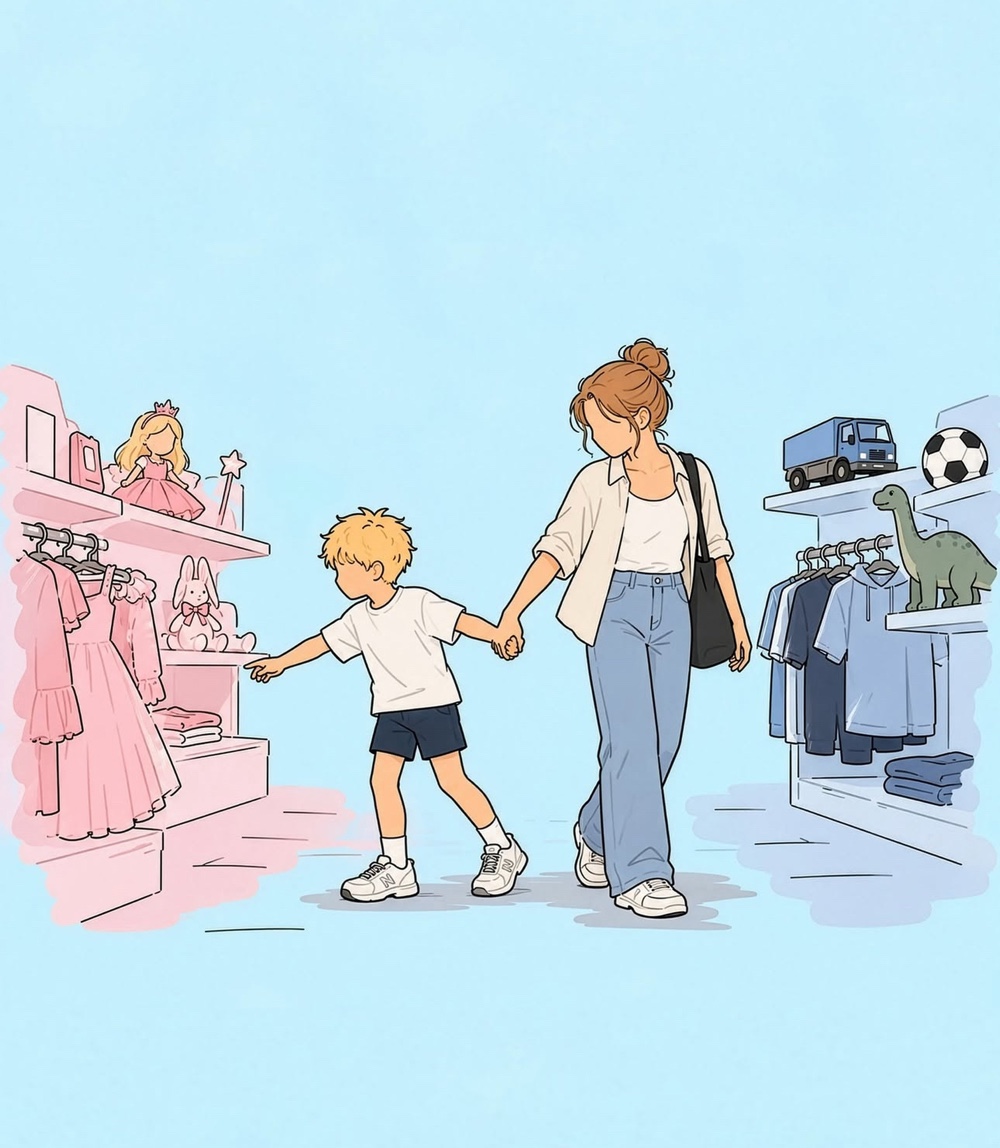 |
We begin learning society’s expectations long before we understand what sexuality even means. Little boys are supposed to like trucks, sports, and rough-and-tumble games. Little girls are supposed to like dolls, dresses, and playing house. Those expectations are so deeply ingrained that a child who steps outside them can be made to feel that something is wrong.
The second illustration shows a little boy reaching toward a princess dress while his mother holds his hand. It is such a simple, innocent moment. He sees something beautiful that interests him. Yet we know how easily that innocent curiosity can become a source of embarrassment for the adults around him.
There is nothing inherently wrong with a boy who likes princess dresses or a girl who prefers toy trucks. Nor do childhood interests determine someone’s sexual orientation or gender identity. But society often treats these differences as warning signs that a child needs to be corrected.
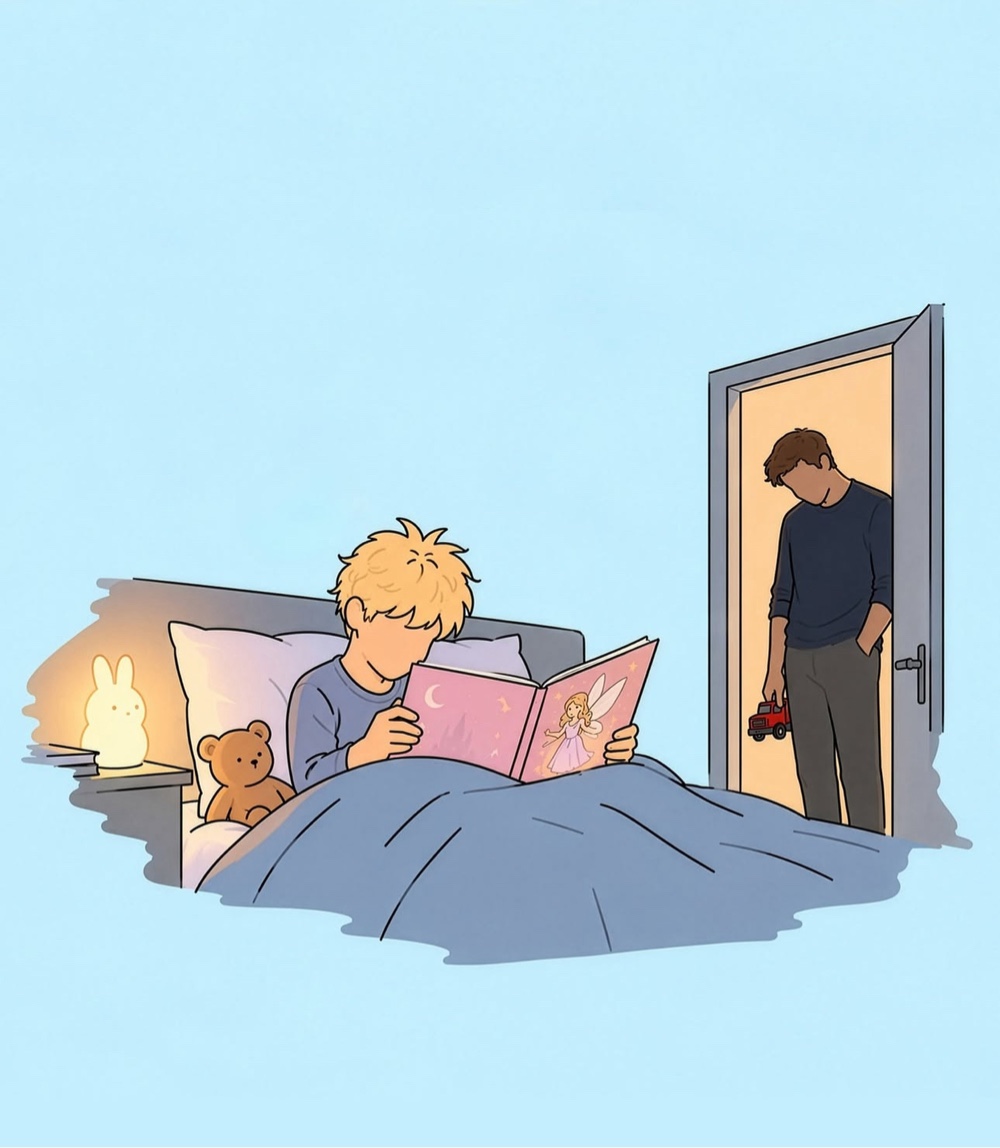 |
The next illustration shows the same little boy reading a fairy tale in bed while a man, presumably his father, stands in the doorway holding a toy truck. There is something heartbreaking about that image. The child is perfectly content, absorbed in a story that brings him happiness, while the adult seems to represent the expectations that will eventually intrude upon that happiness.
It reminds me of my own childhood.
When I was in elementary school, I preferred playing with the girls at recess rather than joining the boys in flag football. My father was embarrassed by this. On the occasions when he picked me up from school, I knew I had to play flag football with the other boys. Thankfully, those occasions were rare. Recess came at the end of the school day, so I could usually enjoy myself without worrying about whether he would see me.
It seems like such a small thing now, doesn’t it? A little boy wanting to play with the children whose company he enjoyed. Yet even then, I was learning that being myself was something to be ashamed of.
 |
As children grow older, the expectations become more rigid, and the consequences of being different can become more painful.
We learn that certain gestures are too feminine, certain interests are unacceptable, and certain ways of speaking or walking invite ridicule. Every movement, every word, every laugh becomes something to scrutinize. We are no longer simply living our lives. We are performing a version of ourselves designed to make other people comfortable.
And when we fail to perform convincingly enough, we are reminded of our supposed shortcomings.
 |
Sometimes that ridicule becomes something much worse.
School was often a living hell for me because of the bullying I endured. Years later, when I finally told my mother how miserable I had been, she asked why I hadn’t told my parents at the time.
The answer was simple: I was embarrassed.
I already knew what I would likely hear. My father had told me often enough to quit being such a sissy.
How could I turn to the very people who were supposed to protect me when I feared they would simply reinforce what my tormentors were saying?
For many LGBTQ+ children, home is not always a refuge from the cruelty they encounter elsewhere. Sometimes the expectations at home are simply a quieter version of the same rejection they experience at school.
And the damage can last long after childhood has ended.
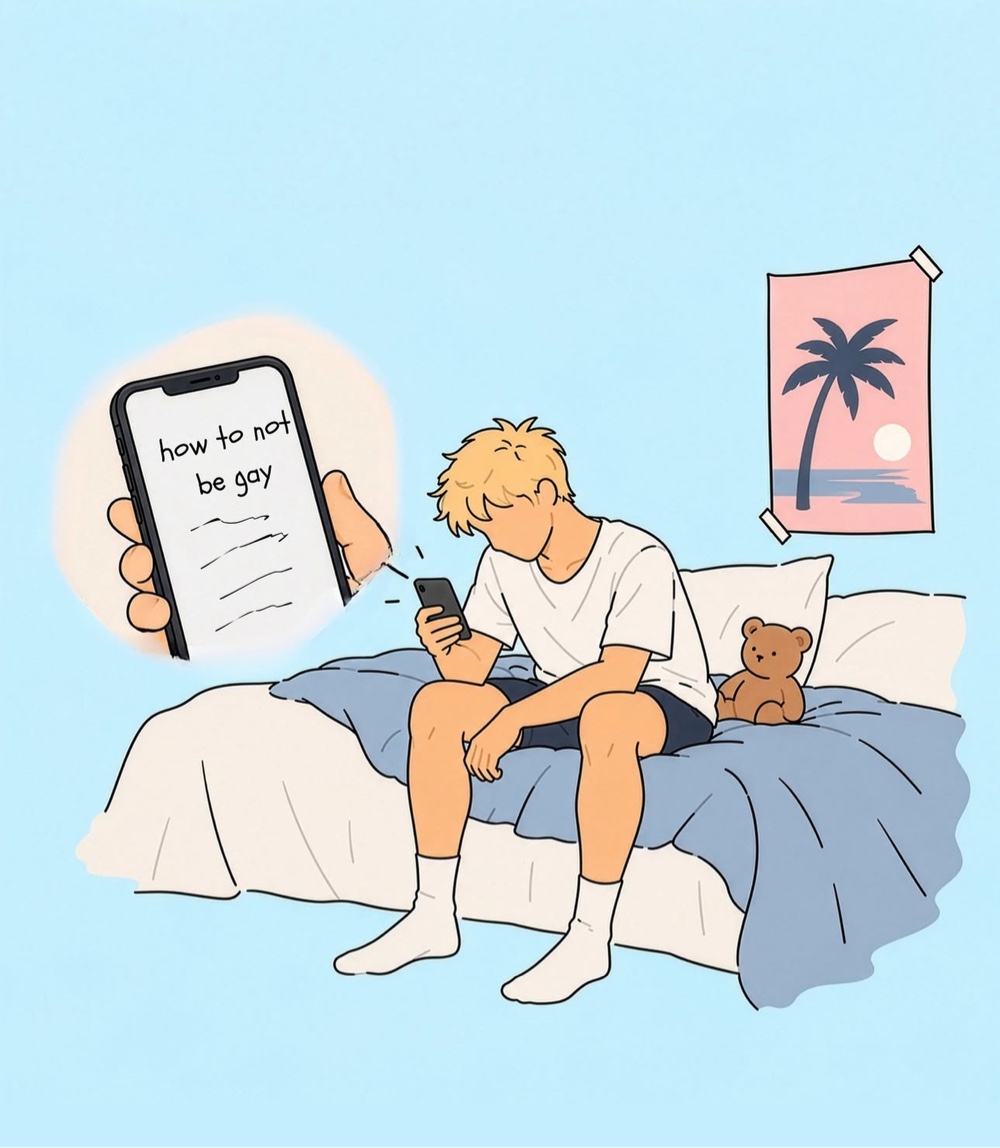 |
Eventually, the voices of others become the voices inside our own heads.
The next illustration shows the young man sitting alone on his bed, searching his phone for ways not to be gay. By this point, he has learned the lesson the world has been teaching him: if he could just change who he is, perhaps the suffering would stop.
But we cannot build a healthy life upon the belief that our very existence is a mistake.
This is where Paul’s words in Romans 12:2 become especially meaningful: “Do not be conformed to this world, but be transformed by the renewing of your minds.”
For LGBTQ+ Christians, that can mean refusing to accept the world’s insistence that our sexuality or gender identity makes us less worthy of God’s love. It means recognizing that the prejudices of society, even when preached from a pulpit, are not necessarily the will of God.
The transformation Paul describes is not about changing our sexual orientation or gender identity. It is about renewing our minds and changing the way we understand ourselves, our relationship with God, and our place in His creation.
For some of us, the most difficult transformation God asks of us is not to change who we are, but to change what we have been taught to believe about ourselves.
 |
Sometimes the people who hurt us do not even realize they are doing so.
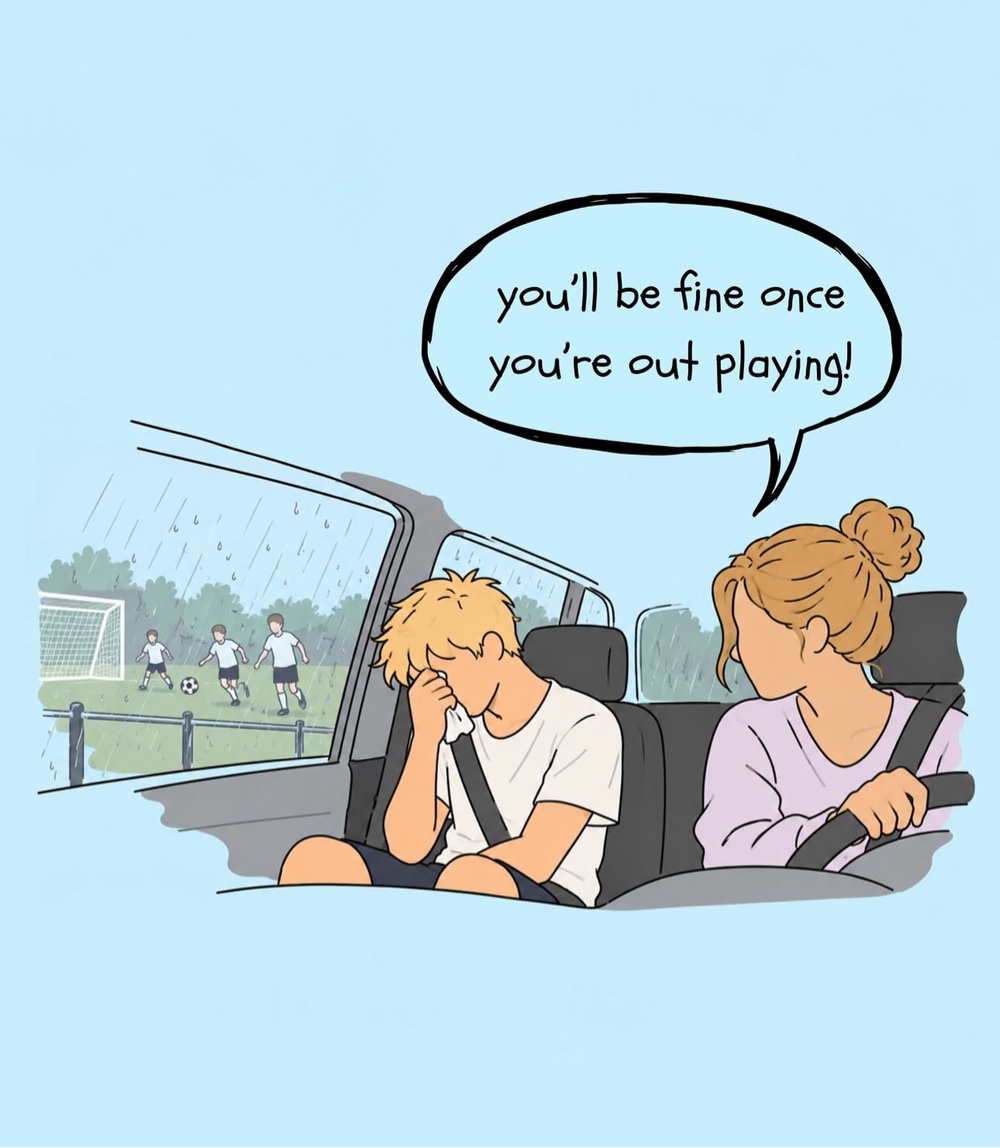
The illustration of the boy crying in the car while his mother assures him that he will feel better once he gets out and plays soccer is particularly painful to me. It reminds me of those afternoons when I felt compelled to play flag football because my father might be watching.
Perhaps the mother in the illustration genuinely believes that joining the other boys will make her son happy. Perhaps she cannot understand why something that seems so ordinary to her causes him such distress.
But good intentions do not always prevent harm.
When we insist that children conform to our expectations rather than allowing them to discover who they are, we teach them that our approval is conditional. We teach them that love and acceptance must be earned by becoming someone else.
And for a child who already feels different, that can be devastating.
 |
Those expectations do not disappear when we grow older.
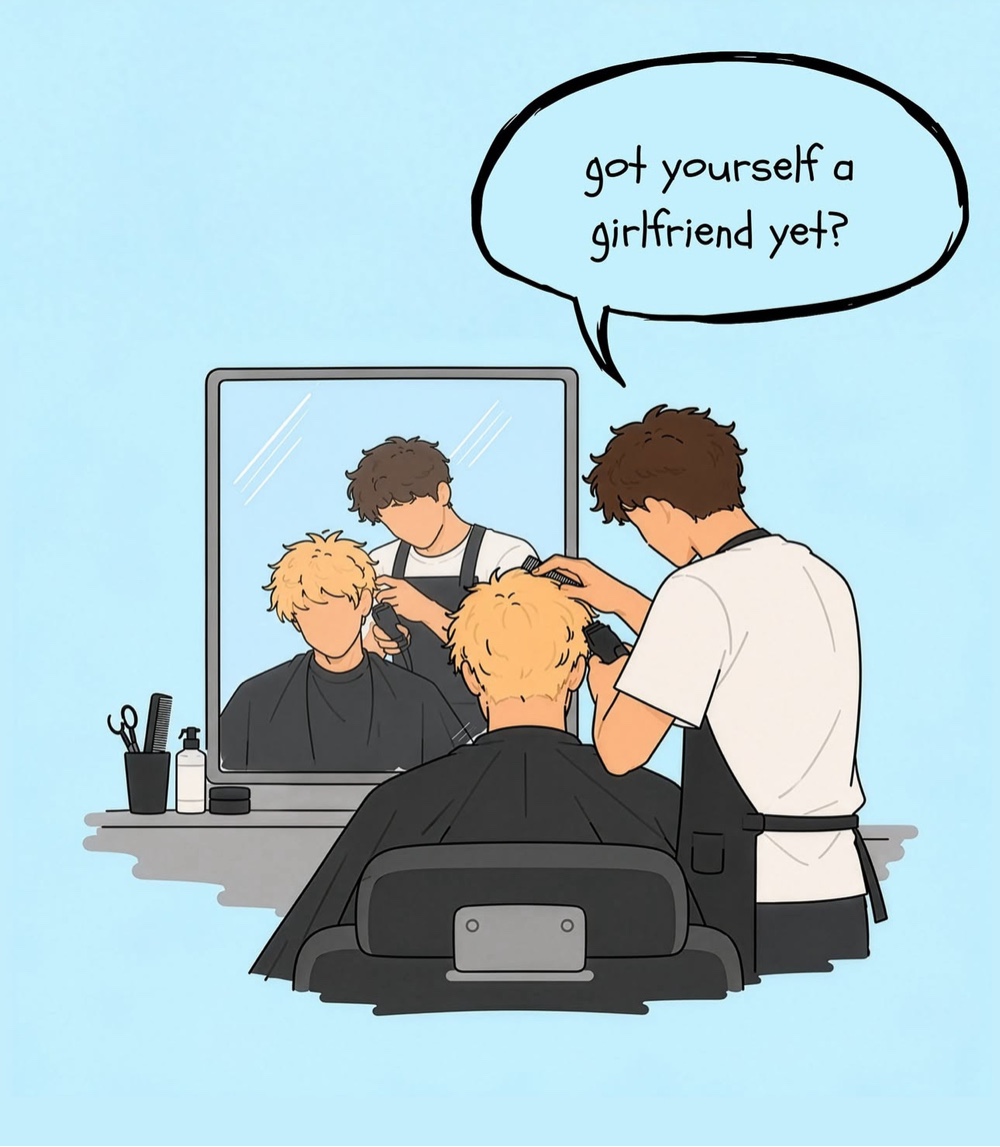
The questions simply change. Have you got a girlfriend? When are you going to settle down? When are you going to get married?
For heterosexual people, these may seem like harmless questions. For someone struggling with their sexuality, they can be painful reminders that the life others expect of them is not the life they are meant to live.
My friend, who is considerably younger than I am, told me something during our conversation that I found both beautiful and heartbreaking. He said he had reached a point in his life where he would choose to be gay again in every lifetime.
I wish I could have said that when I was his age.
For much of my life, I felt that I faced an impossible choice: keep my family or be myself. I could not have both. My family has never fully accepted me for who I am, and that rejection leaves wounds that do not simply disappear with time.
My friend’s words represent a freedom that I wish I had known much earlier in life. But I also recognize that we come to self-acceptance through different experiences, at different times, and sometimes through extraordinary pain.
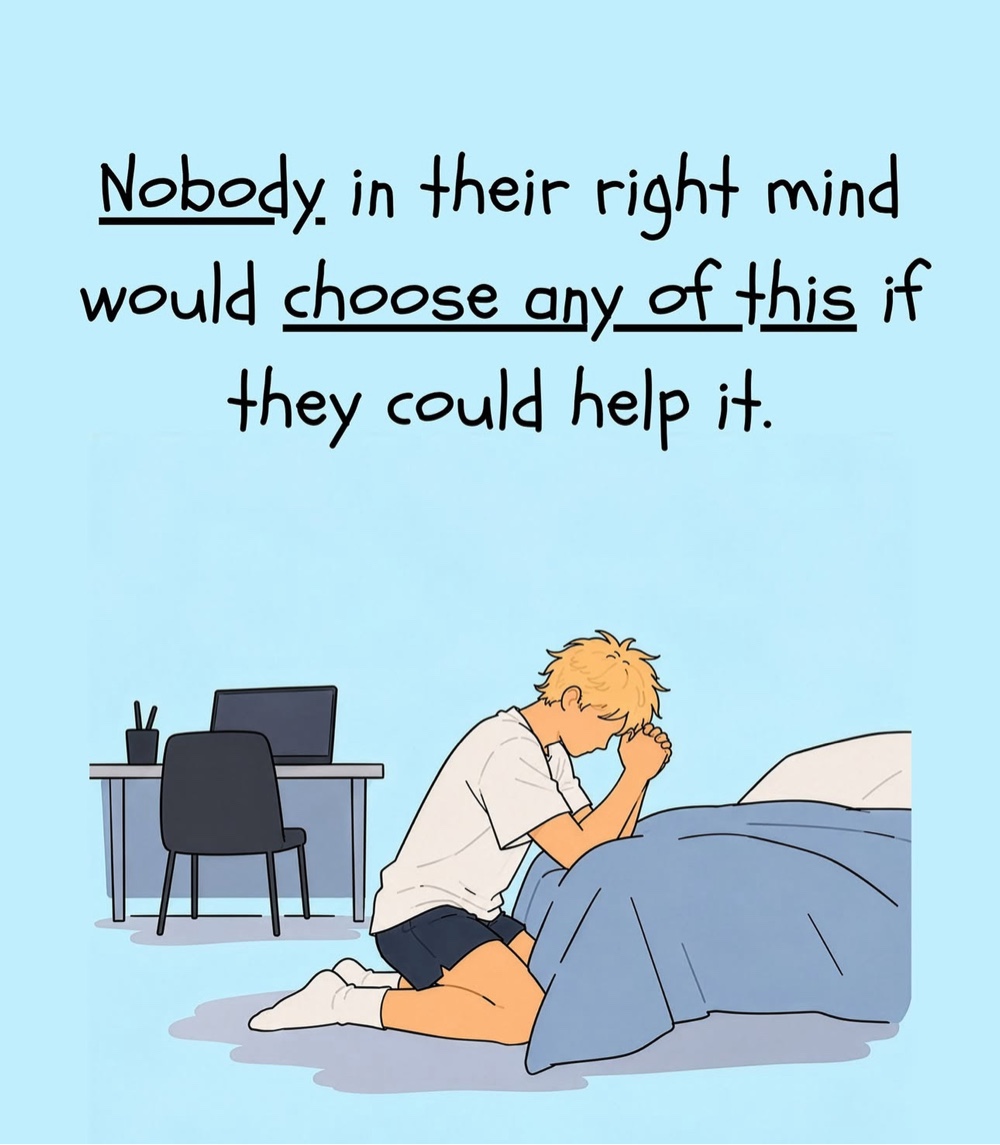 |
I think this illustration captures something that is often misunderstood about the LGBTQ+ experience.
When someone says they would never have chosen to be gay, they are not necessarily saying that being gay is wrong. Sometimes they are saying that the suffering imposed upon them has been so great that they cannot imagine willingly choosing to endure it.
But we must be careful not to confuse the source of that suffering.
The problem is not the child who prefers playing with girls, the boy who loves fairy tales, or the young man who dreams of loving another man. The problem is a world that teaches them to be ashamed of those things.
There is nothing inherently shameful about being LGBTQ+. The shame comes from the judgments others impose upon us and the judgments we eventually learn to impose upon ourselves.
And unlearning those judgments can be one of the most difficult journeys we ever undertake.
The final illustration shows the young man kneeling beside his bed, his hands clasped in prayer.
I wonder how many LGBTQ+ Christians have knelt beside their beds and begged God to make them different. How many have prayed for their feelings to disappear, for their desires to change, or for the strength to become the person their families and churches expected them to be?
How many have interpreted God’s silence as evidence that they were unworthy of His love?
But what if we have been praying for the wrong kind of transformation?
What if God does not want us to become someone else? What if He wants us to learn to love the person He created?
Paul tells us that through the renewing of our minds, we “may discern what is the will of God—what is good and acceptable and perfect.”
For me, that renewal begins with recognizing that I can be both authentically gay and faithfully Christian. These are not competing identities. I do not have to choose between loving God and accepting myself.
But I also know that reaching that understanding is not as simple as deciding one morning to think differently.
For those of us who have spent years, sometimes decades, being told that something fundamental about us is wrong, learning to love ourselves can be extraordinarily difficult. The voices of condemnation do not simply disappear because we have decided to stop listening.
And I would never suggest that a change in attitude, a stronger faith, or a renewed commitment to God can magically solve every problem. The damage caused by years of rejection, shame, and fear can be profound. Depression, anxiety, and trauma are not signs of spiritual weakness, nor are they evidence that we have failed to trust God.
Sometimes healing requires therapy. Sometimes it requires medication. Sometimes it requires both, along with the love and support of people who accept us exactly as we are. There is no shame in seeking professional help, and doing so does not demonstrate a lack of faith.
Faith and medical treatment are not opposing forces. They can work together to help us become healthier, happier, and more fully ourselves.
The important thing is to begin.
Begin by questioning the voices that have told you that you are unworthy. Begin by recognizing that your identity is not something for which you must apologize. Begin by treating yourself with the same compassion you would offer someone else who was struggling. Begin by understanding that loving yourself is not selfish, and accepting yourself is not sinful.
Most importantly, begin by recognizing that you can be both authentically LGBTQ+ and faithfully Christian.
When we stop exhausting ourselves trying to satisfy everyone else’s expectations, we create room for something extraordinary. We begin to discover who we really are, what we believe, and how we can use the gifts God has given us.
And perhaps that is when we can begin to discern God’s will for our lives more clearly.
Perhaps our experiences of rejection will make us more compassionate toward others who suffer. Perhaps our struggles will give us the courage to stand against injustice. Perhaps the love we once believed we were unworthy of receiving will become the very love we offer to someone else who desperately needs it.
And perhaps, simply by living openly and faithfully, we can help another LGBTQ+ person understand that they, too, have a place in God’s kingdom.
I think about that little boy who was afraid to be seen playing with the girls at recess. I wish I could go back and tell him that there was nothing wrong with him. That he didn’t need to change the way he walked, talked, or held his hands. That he didn’t need to pretend to enjoy things he disliked simply to prove that he was masculine enough.
Most of all, I wish I could tell him that God loved him exactly as he was.
None of this means that life will suddenly become easy. There will still be people who reject us, churches that exclude us, and days when old insecurities return. Transformation is rarely a straight path, and healing does not mean that every wound disappears.
But we do not have to be perfect to begin living freely. We do not have to have all the answers before we can love ourselves. And we certainly do not have to become someone else to be worthy of God’s grace.
We can love ourselves, embrace who we are, and devote our hearts and spirits to God. These are not separate journeys, but parts of the same transformation.
And as our minds are renewed, we may discover that the freedom we have been searching for does not come from finally becoming what others wanted us to be. It comes from accepting who we have always been, recognizing God’s love within us, and allowing that love to shape the way we live.
For when we are no longer consumed by the struggle to deny ourselves, we are free to devote our energy to something far greater: loving God, loving our neighbors, and making a difference in a world that desperately needs more compassion, understanding, and grace.
God does not call us to conform to someone else’s idea of who we should be. He calls us to be transformed by His love, so that we can become more fully the people He created us to be.

No comments:
Post a Comment