Tuesday, June 12, 2012

Shakespeare's Sonnet 33


No. 35, Gay or Bi Shakespeare (or was deVere his ghost writer?) Shakespeare is in love with a younger man, but is lamenting his loss of what had been a loving relationship.

SONNET 33

Full many a glorious morning have I seen

Flatter the mountain-tops with sovereign eye,

Kissing with golden face the meadows green,

Gilding pale streams with heavenly alchemy;

Anon permit the basest clouds to ride

With ugly rack on his celestial face,

And from the forlorn world his visage hide,

Stealing unseen to west with this disgrace:

Even so my sun one early morn did shine

With all triumphant splendor on my brow

But out, alack! he was but one hour mine,

The region cloud hath mask'd him from me now.

Yet him for this my love no whit disdaineth;

Suns of the world may stain when heaven's sun staineth.


Comment: "Between the time Shakespeare wrote Sonnet 32 and 33, the poet's entire attitude toward his relationship with his young friend had changed. While he had been focused on his own mortality throughout Sonnets 27-32, now the poet has a new and more pressing dilemma to jar him from his previous obsession. In Sonnets 33-35 the poet makes it clear that he has been deeply hurt by his young friend, who many believe to be the historical Earl of Southampton, Shakespeare's patron. We cannot say what specific wrong-doing prompted such displeasure, although we can assume that the young man had many interests other than the poet, and he may have surrounded himself with other friends (and possibly other lovers), leaving the poet feeling isolated and unwanted. The poet's dislike of his friend's actions are clear from the overall reading, but also from his choice of words: "ugly", "disgrace", "basest", "disdaineth", and "staineth." Moreover, the sun permits the clouds to cover his face as he cowers off to the west, and the direct comparison is made between the sun and the poet's friend in the third stanza. Even though he denies it in the concluding couplet, the poet seems to resent the friend for causing a rift in their relationship. 

"As mentioned, the sonnet does end on a positive note with the poet ready to forgive his friend, content to accept that disappointment in this life is wholly natural. "Two Renaissance commonplaces, the sun-king comparison and the sun-son word play, are put to such good use in the friend's behalf that 'out alack', the emphatic but conventional phrase denoting the speaker's regret, seems no more than a polite formula."

Source of Sonnet and comment: http://www.shakespeare-online.com/sonnets/33.html 

Mabillard, Amanda. An Analysis of Shakespeare's Sonnet 33. Shakespeare Online. 2000. (day/month/year you accessed the information) <http://www.shakespeare-online.com/sonnets/33detail.html >. 


Comment and Notes of Another Shakespeare Scholar: "A sonnet that hardly needs an introduction. This and the following record a rejection by the youth of the poet. How serious or real this was we have no means of knowing. Perhaps it is an imaginary interlude in the sonnet sequence. Most readers however take it as having autobiographical content, and that approach is given credence by what appears to be the genuineness of the sorrow, and by the fact that the episode of estrangement, whatever caused it, is dealt with in this and the following three sonnets. 

"The fact that we are more disposed to believe in the biographical truth of the sonnet because of its beauty of imagery and language is a reality of human nature which cannot be easily dispensed with. It would be disapponting to learn that the youth and the poet's impassioned love for him were mere creations of an idle brain, with deliberate intent to lay a false trail and make truth out of fiction. For while we may allow that a Macbeth and a Hamlet are engendered in the heat of artistic creation, their existence gives us a vicarious experience which is not harmed by their fictional reality. I am not convinced that this is so with the sonnets, for we long to trust their sincerity, and to see what it teaches us of our own capacity for love, what it explores and what it defines. Therefore I always assume what I take to be the standard or Wordsworthian approach (pace Browning), that this is a true record of love, no doubt edited and embellished, (for who could ever be word perfect in such matters?). 

"But we have to acknowledge also that the lover's frown and her (in this case his) overcast brow, like the sun clouding over on a fine morning, was also a part of the sonnet tradition. Shakespeare was here making use of that rich tradition, as well as recording in his own inimitable way the feelings of one so cast down by his beloved's disdain." 

Notes: 

1. Full many a glorious morning have I seen: Full many = very many.

2. Flatter the mountain tops with sovereign eye: Flatter - also has the meaning to stroke. In its normal sense it conveys the idea of insincerity and deception, and ultimate disillusionment. Hence the morning sun was making the mountains appear more brilliant than they in fact were.  sovereign eye = majestic, kingly gaze. Note that here the usual flattery of king by subject has been reversed. The king flatters his courtiers, the mountains.

3. Kissing with golden face the meadows green: The sun kisses the earth. The glorious morning is partly subsumed into the character of the sun, as a result of sovereign eye and kissing.

4. Gilding pale streams with heavenly alchemy: Gilding = turning to gold; covering with gold. alchemy - this was the science which sought to discover how to turn base metals into gold. It was considered to be part magic, part science, and had a reputation for trickery and deceit. Nevertheless Elizabeth employed an alchemist in the early years of her reign, having been lured by the prospect of large sums of gold…

5. Anon permit the basest clouds to ride: Anon = very soon, almost immediately; permit - the subject is morning line 1, and, by implication, the sky and the sun.basest = blackest, dirtiest, of humble origin; low born. Cf. Edmund in King Lear:…Why brand they us With base? with baseness? bastardy? base, base? I.2.9-10. There is also a contrast with gilding and alchemy. Base metals were the ugly materials of the alchemist's study, which were destined to be turned into gold, the noblest metal of all.to ride - as horsemen. The clouds ride on the face of heaven as horsemen ride on the face of the earth.

6. With ugly rack on his celestial face: rack = a line or procession of moving clouds; thin, flying, broken clouds, or any portion of floating vapor in the sky.(Webster's) The winds in the upper region, which move the clouds above, which we call the rack, … pass without noise. Bacon. his = the sun's, the sky's, the morning's.

7. And from the forlorn world his visage hide:the forlorn world - the world becomes forlorn, presumably because it is darkened by the ugly rack of clouds, which hide the sun's celestial face (visage).

8. Stealing unseen to west with this disgrace:Stealing = moving furtively, stealthily, like a thief.  with this disgrace = with the disgrace of having his visage blotted out. disgrace could also refer to physical disfigurement.

9. Even so my sun one early morn did shine:my sun = the youth whom I love; you; the heavenly eye of my life. This is however the first mention ofsun in the sonnet.

10. With all triumphant splendour on my brow: all triumphant splendour = gloriously arrayed, in total splendour. triumph conveys the idea of a triumphal procession, a procession to commemorate the victory of a famous commander. on my brow = upon my forehead, upon my face.

11. But out, alack, he was but one hour mine:But, out, alack - editors gloss this as being an emphatic way of saying 'Alas', out being an intensifier, and cognate with its use in expressions such as 'out upon it!'. However I think it also has reference here to the sun, which was only 'out', i.e. shining, for one hour. he was but one hour mine = I enjoyed his (the sun's, my love's) presence for only one hour.

12. The region cloud hath mask'd him from me now: The region = the upper air, the upper region of the sky. him = my love, (the sun).

13. Yet him for this my love no whit disdaineth: him….my love - these cannot both refer to the youth. If my love = the youth, then him must be the sun of 5-8 and 9-12, which has been disgraced by clouds ruining his face. But if him refers to the youth, then my love is 'my love for him', personified, which does not disdain him (the youth) for having become inaccessible. no whit = not in the least, not a jot.

14. Suns of the world may stain when heaven's sun staineth: The homophonic meaning, sons, is played upon. Sons of the flesh are also liable to blemish and disgrace, as heavenly suns are. stain can be used transitively or intransitively, so that the youth, as well as becoming stained himself, has passed the infection on to others.

Source of 2nd scholar's comment/notes: http://www.shakespeares-sonnets.com/sonnet/33

For more on Shakespeare:http://artofmalemasturbation.tumblr.com/Shakespear and http://artofmalemasturbation.tumblr.com/sonnets (NSFW)

Monday, June 11, 2012

Nashville Pride

From the tapping of a hundred activists' feet on a downtown sidewalk 20 years ago to a city-wide celebration that draws thousands of LGBT community members and their straight allies, the growth of Nashville Pride has ebbed and flowed over the years thanks to the efforts of dedicated volunteers both past and present.

A culmination of events led to the birth of Nashville's first Pride event in 1988. In 1987, following organizing that resulted in the founding of T-GALA (Tennessee Gay and Lesbian Alliance), two chartered buses took members of Nashville's LGBT community and their supporters to Washington D.C. to participate in the Second National March on Washington for Lesbian and Gay Rights. That same year, Stewart Biven and Jeff Ellis began publishing Dare (later Query), Nashville's first LGBT publication.

"Query started people communicating", Linda Welch, publisher of the LGBT weekly newspaper InsideOut and former Nashville Pride Board co-chair said. "They'd pick up the paper and were able to see what was going on in the community." With the lines of communication now firmly in place, members of the local community, with the help of the National Gay and Lesbian Task Force, were able to put together Nashville's first Pride March in June 1988. A modest 125 people met at Fannie Mae Dees (Dragon) Park that year with signs, walked through Vanderbilt University and then across West End Avenue into Centennial Park.

Because of the tense social climate at that time, participants in Pride events took on a more activist role than do most people today, Welch said. "In the beginning, there were tons of protesters," said Welch. "You never knew if you'd turn a corner and have protesters there or have someone drive by and scream. Back then it was more of an activist thing, especially for those who were out or were coming out."

Jim Hawk, the current executive director of the LGBT cultural center OutCentral, stepped out of the closet in the early '90s and directly into a leadership role organizing Pride for two years. Welch said Nashville Pride remained a small event drawing in only a few hundred participants and a couple of vendors each year until Hawk took the reins. "He [Hawk] turned Pride around," Welch said. "It was a machine similar to what Nashville has now." Hawk and Dewayne Fulton, president of the LGBT youth organization One-in-Teen, worked together with one main goal in mind — to make Nashville Pride bigger than it had ever been.
"We thought we could grow Pride if we pulled the entire community together," Hawk said. They met with a variety of people from across the city and recruited people from different backgrounds to sit on the board.
"We thought it was important to get several points of view when planning the events," said Hawk.


Hawk hosted the first Pride Ball at the Parthenon in Centennial Park, which helped raise the thousands of dollars necessary to turn Pride into a week-long celebration. More than 100 volunteers worked with the board on planning fundraisers and booking entertainers. The standard for Nashville Pride had been set. After two years at the helm of the Nashville Pride Board, Hawk handed the duties over to Welch and Brad Beasley. (Beasley currently serves as the STD/HIV prevention and control director at the Metro Health Department.)

In 1995, Pride co-chairs Welch and Beasley moved the event to Riverfront Park. Raising the bar again that year, Beasley raised enough money to provide an officer on each street corner to block streets allowing for horses, motorcycles and floats in Nashville's first Pride Parade. An estimated 8,000 people attended Nashville Pride that year. Welch said the board exceeded their budget that year after having flown in five speakers. She and other board members were forced to walk through the crowd selling t-shirts and sodas to raise enough cash to pay the entertainers (who had heard there was no money left) before they would perform that day.

"We had to raise another couple hundred dollars in a half hour in order to pay each upcoming act," added Welch. "But we did it. It was a really big success!"


Since Nashville Pride is organized solely by unpaid volunteers, there has always been a cycle of highs and lows for the event during times of turnover and change on the Pride Board. Pam Wheeler, community activist and current co-host of Out & About Today, got involved with Pride in early 2000, a time when Nashville Pride almost didn't happen. It was nearing time for the annual event but no one knew who was in charge of planning. "A group of community leaders realized nobody was planning a Pride event in 2000," Wheeler said. "So, some of us decided to step up and quickly get involved to avoid a lapse. We discovered the existing organization was no longer active after checking with the Secretary of State's office." Soon thereafter, an ad appeared in Xenogeny, the LGBT weekly newspaper now known as InsideOut, calling for community members to get together to discuss saving Pride. An estimated 70 people attended the meeting, Wheeler said. With just 90 short days for planning, then Pride President Raney Pollos, with help from community leaders Keith Hinkle, Matthew Strader, Wheeler and a few others, successfully pulled off Nashville Pride 2000 at the Bicentennial Mall. Approximately 2,000 people and 30 vendors attended the event, up about 1,000 visitors from the previous year when volunteerism had lagged and the success of Pride dipped below the norm, Wheeler said.
Over the next few years under the leadership of Wheeler and subsequent presidents Mikhail Brown, Michael Basham and Todd Grantham, volunteers and/or board members David McKinnon, Brent Meredith, Marty Sewell, John Wade, Pamela DeGroff, Jason Adkins, Emily Benedict, Pat Finn, DeMarko Smith, Anthony Mollo, Jeanna Emert, MAC, Doug Sladen, Josh Baker and many others (too numerous to list here) joined Nashville Pride with a desire to help take it to the next level. Most of these volunteers had been to Pride in other nearby cities and wanted to see their hometown Pride grow and thrive. They wrangled their experiences together to create Pride events unique to Nashville and spent months planning the event, running TV and radio ads and bringing in new local and national sponsors. The crowd grew exponentially through the early 2000s and reached the volume most people recognize as Nashville Pride today.

National attention was garnered by the festival in 2010 when headlining entertainer, Vanessa Carlton, came out to the attendees. She began her set by saying "I've never said this before, but I am a proud bisexual woman." (Leslie, J.: "Celebrating 20 years of Nashville Pride", Out and About Newspaper)


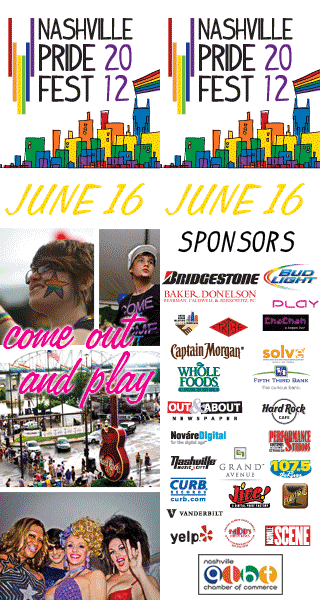
The 24th annual Nashville Pride Festival will be held Saturday, June 16, at Riverfront Park from 11 a.m. to 7 p.m. The annual event is a chance for the GLBT community and its allies to gather in celebration of advances made for GLBT equality.

The excitement of Pride weekend begins on Thursday, June 14, with Curb Records Pride Rocks! Pre-Party at the Hard Rock CafΓ©, highlighted by Hydrogen Blonde, an explosive high energy cover band that plays a wide variety of hit songs. The band has become a staple in the East Nashville music scene performing monthly at The Lipstick Lounge.

This year's festival is expected to be the most highly-attended to date and boasts an eclectic entertainment lineup that includes Hello Kelly, Jen Foster, Ian Harvie, Jermiah Clark, Antigone Rising, Kerli and Kristy Lee on the Bridgestone Main Stage. A variety of popular local acts will also perform throughout the day on the Local Stage and the Tribe & Play Entertainment Stage will be home to DJ's and drag performances.
"We are so excited about this year's beefed-up festival, especially with new additions like our Equality Walk presented by Fifth Third bank and an entertainment lineup as diverse as Middle Tennessee's LGBT community" said President Randall Roop.


Feisty, Nashville-based Hello Kelly takes the Main Stage just after noon. Knowing the life on the road is no place for the faint of heart, the alt-rock band has returned to the grind with a transformed sound that is harder, faster and more sincere, making it clear that Hello Kelly is in do-or-die mode with a tenacity never-before seen.


Jen Foster follows singing about the time her lover moved out and took everything she owned in "Taking Bob Dylan" and about the jaded American culture in "Closer to Nowhere. An award-winning singer/songwriter who regularly sells out shows all over the country, Foster often draws a devoted following to her live shows, though her largest fan base resides in the Southeast. Her bond with fans will create a captive audience, eager to hear her stories.

The day's entertainment will switch gears in the afternoon when the world's first FTM transgender comic, Ian Harvie, takes the stage. Frontiers Magazine referred to Harvie as "quite possibly the most unique stand up comic in the country" with his eccentric views on love, families, adolescence, substance abuse, and gender identification, as well as his acute dissection on the circus act that is the stunt double for today's popular culture.

Jeremiah Clark returns the entertainment to music as he masterfully balances poetry with practicality similar to Rufus Wainwright and Tracy Chapman. While his songs usually take on a more serious tone, his performance is sure to be refreshingly lighthearted. He enjoys telling comedic stories about family, friends and traveling between tunes joking that, "If you don't laugh AND cry at some point during the show, I simply have not done my job."

The mighty rumble of Kristy Lee, an Alabama alternative artist with a voice like thunder rolling in before the sweet southern rain, as well as the newly-redirected Antigone Rising, a female rock band that has opened for Rob Thomas, Aerosmith and The Rolling Stones, round out the event's main stage entertainment as they sandwich Estonian recording artist Kerli and her unique electronic/pop/experimental sound.
General admission to the event is $5 and allows access to more than 75 vendors in the Nashville GLBT Chamber Marketplace, mobile food vendors, cold cocktails and frozen drinks, misting fans, karaoke, street performances, an inflatable kids' zone, prizes and much more. VIP tickets are $50 and include food and drink at the festival. All proceeds from ticket sales benefit Nashville Pride. This event is included in CORE 100 membership which offers discounted tickets to supporters. VIP tickets are available online and include private bar, two drink tickets, food and private restrooms in the Captain Morgan VIP area. ("Come out and play at 2012 Nashville Pride Festival," Out and About Newspaper) 


For a visitor's guide with some helpful links, check out the rest of the post by clicking "More" below.

Sunday, June 10, 2012

Pride or Prejudice: A Look at Gay Pride Parades


As Gay Pride season arrives, we often look back at the legendary uprising at Greenwich Village's now-historic Stonewall Inn. It was there that brave men and women raised up their hands and fists and said, "No more!" People were tired of being harassed, tired of being corralled and led away in shame and dishonor, tired of being treated like second-class citizens.

When the Stonewall was raided shortly after midnight on June 28, 1969, a group of gay men, lesbians, drag queens, street youth, hustlers and more fought back against the police. They used coins, bricks, garbage, bottles and their voices to tell the "authorities" to step the fuck back.

Two years later, the first Gay Pride parades took place in Los Angeles and New York and have spread to cities large and small the world over. But after 40 years, do we still need to gather in the streets in our capitals and small towns to tell the world, "We're here. We're queer..."? Ah, you know the rest.

It's an interesting concept, the "pride parade." Whether it's to show Puerto Rican pride, Irish pride, American pride or Gay Pride, people want to gather in the streets each year to say, "Hell yeah, this is who I am and I love it!" But do annual Gay Pride parades still have the same objectives and reach the same goals today as they did 20 —or even 10—years ago? The gay community has made major strides in the last decade. We have representatives in politics, entertainment, sports, science and adademics, and we are allowed to get married or have a civil union in dozens of countries and a number of U.S. states. Yet we still have a ways to go before we truly have equality.

When you think about Pride in your town or city, what first comes to mind? Is it the riots that started our gay liberation? Is it the political factions who helped us get where we are? Perhaps it's the companies that supported our rights to work alongside straight people and get the same benefits. Or do you just think about how messed up you're going to get while watching hot, buff, gyrating go-go boys toss beads your way?

In turn, how does society look upon gay pride parades?  Many right-wing conservatives see pride parades as a shameless display of hedonism.  I've heard friends of mine who I've talke to about pride parades, who are also pro gay rights, but still see the displays of flesh and costumes as a bit too much.  So what can we do to enhance the image of gay pride parades.  We will never get everyone to support the parades, but it does often shed a bad light on the LGBT community.  I read one comment on a website that stated "They may be gay or in support of Gay [rights] but they are clearly exhibitionists! Gay parades are like Halloween parades, and some of the costumes are offensive, But if that is the message they want to send, they will never be taken seriously." Is it the message we want to send? I don't think it is, but some people will never like what we do regardless.  I will say this, the times that I have been to gay pride parades, I had a blast.  It was a lot of fun and it was a place for LGBT people to celebrate our lives and love for one another.

However you view your Pride, you can't deny we got to this place today by the support and help of a lot of people. Whether you were in the trenches fighting or benefited from those actions, each summer we come together to remember how we got here.

But why can't we do this everyday? There is plenty of dissension within our community—gay men who hate lesbians (and vice versa), homos who hate drag queens, gay people who think the trans "T" people should be removed from the LGBT, racism among gays, and more. Indeed, these kinds of feelings should make us all take pause and ask what it is we're proud of. If each of us takes a step back and thinks about it, we can remember something in each of our lives that makes us proud to be gay. But is it because of some political victory, a civil rights issue, a politician or company, or a big fat party?

Yes, there are many ways to show Gay Pride. Just make sure you do something on one of the other 364 days of the year as well.

Friday, June 8, 2012

All About the Party


Sunday is a close friend of mine's birthday, but we are having the party for her tonight.  She generally cooks for me, so tonight as a treat for her, I am cooking a real Italian feast.  Italian food is one of my specialties, so I am cooking chicken piccata as the main course.  I think she will enjoy it. So I'm going shopping in the morning, spending the afternoon with her "partying" and then cooking in the evening for all the guests.  I love to cook for people, so this will be a lot of fun for me, and I hope yummy for the guests.  I think it will be a fun day, and I hope that she will enjoy it. She does so much for me, that I just want to do something special for her.

Thursday, June 7, 2012

Iran's LGBT Community


LGBT rights in Iran since the Iranian Revolution of 1979 have come in conflict with the penal code, with international human rights groups claiming floggings and death sentences of lesbian, gay, and bisexual individuals. Homosexuality is a crime punishable by imprisonment, corporal punishment, or in some cases of sodomy, even execution of the accused is legal under the laws of this country's theocratic Islamic government. Iran insists that it does not execute people for homosexuality, and those executed had either committed rape, murder, or drug trafficking.

In 2007, Iranian President Mahmoud Ahmadinejad, speaking to Columbia University, said, “In Iran we don’t have homosexuals like in [the US]. In Iran we do not have this phenomenon. I don’t know who has told you that we have it.” A spokesperson later stated that his comments were misunderstood. In January 2012, Mohammad Javad Larijani, the secretary-general of the Iranian High Council for Human Rights, described homosexuality as a "disease," and said that same-sex marriage was "immoral".

Any type of sexual activity outside a heterosexual marriage is forbidden. Transsexuality in Iran is legal if accompanied by a sex change operation; however, transsexuals still report societal intolerance as in most societies.

Although it has some of the strictest laws on sexuality and same-sex relations in the world, Iran also has a reputation for an extremely liberal sex-change operations industry.

According to the BBC, the Iranian regime recently made sexual reassignment even more accessible by announcing that health insurance companies must cover the full cost of sex-change operations, which can cost upward of $3,000.

According to the BBC, Iran performs more sex-change operations than any country in the world except for Thailand; the surgery industry has attracted patients from all over the Middle East and as far away as Eastern Europe. Official statistics for 2007 put the number of transsexuals in Iran between 15,000 and 20,000 people, with unofficial estimates suggesting many more -- up to 150,000, the Guardian reports.

In a country where same-sex relationships are punishable by execution, sex-changing surgeries may mean the difference between life and death.

Iranian-born filmmaker, Tanaz Eshaghian, who brought attention to Iran’s transgender community in her award-winning 2008 documentary film,“Be Like Others,” illustrates the logic behind the law. In one scene of the film, a Muslim cleric explains how Islam supports sex-change surgery. “An action is allowed unless it states specifically in the Quran that an act is a sin. Why is adultery one of the seven deadly sins? Because it specifically says so in the Quran. Because it does not specifically state that sex change is a sin, therefore, we cannot call it a sin.”

Yet while the freedom to change sex might come as a relief to some, Eshaghian also draws attention to the pressure felt by gay men and women in Iran to have sexual reassignment surgeries as a means of legitimizing their sexual orientation. As gay individuals, they are committing a crime. As transsexuals, they can exist under Iranian law.

Ali Askar, a male-to-female who underwent surgery, told the BBC, “If I didn't have to operate, I wouldn't do it. I wouldn't touch God's work."

Gender theorist Afsaneh Najmabadi adds: “For legal and medical authorities, sex change surgeries are explicitly framed as the cure for a diseased abnormality, and on occasion they are proposed as a religioegally sanctioned option for heteronormalizing people with same-sex desires or practices.”

Wednesday, June 6, 2012

I'm Pulling My Hair Out


Teachers work harder than anyone else for nine months out of the year, we deserve our vacation.  There's only one problem though: everyone has something for us to do. And it's all just because they think we have planned nothing ourselves for the summer but to be lazy.  I'm here to tell you that we put off stuff for those nine months (vacations, sleep, house cleaning [at least I do for the most part], just getting some freaking rest, reading books we haven't had time for, finishing a dissertation, and the list goes on.....).  No one seems to get that.  Just like last summer, I am being pulled in a dozen different directions.  Will people ever understand?  I doubt it, but thanks guys for reading my rant.

Tuesday, June 5, 2012

A Poem for Gay Pride


Proud


I hold my head up, barely-
with parades in it, it's heavy.
I look at the world and know
that they're all looking at me.
They are.
I'm important.
I have to be or there wouldn't
be such a beautiful fucking parade,
Right?

At least today they're looking.
They can't really ignore the music
and the sweat, and the skin and the feathers.

Some bring their kids,
I automatically make way for strollers.
I notice lots of dogs, some very fancy.
I get tangled, briefly, in a sparkly leash
when a bulldog in a tutu
takes a turn for  a terrier.

There are beautiful, beautiful people.
Beauty, I know, a distraction from pain.
Smile, it's your day!
They smile, on cue-
they really want to mean it.
There are old people- at least fortysomething.
It's funny, they smile anyway.

Some stand back,
not really there, but they have to be.

And some, I know, are quietly holding
a heavy excuse to beat me with
(they practice on themselves, like I did).
But not today,
They're outnumbered.

Is blue the sky, or the other way round?
Today, it doesn't matter.
My eyes are clear
my back is straight,
my neck getting stronger
with every passing feathery float.

Who Is This Guy?

D Gregory Smith is a gay, HIV+ native Montanan; a Rome-educated former priest now making a living as a licensed mental health counselor and Executive Director of AIDS Outreach - a Bozeman based HIV testing, service and support organization. He is also a teacher, health educator, firm and gentle activist, poet, theologian, spiritual adventurer, future husband, interviewer, geek, opinionated and witty optimist who loves to write- and he does (when he can find time) on his blog From Here to Eternity and at Bilerico.com. He is also a contributor to several other blogs and sites, including the newsmagazine LGBTQ Nation.

As I was looking through D. Gregory Smith's blog, I came across a post of his that I wanted to share with you guys.  It's is titled "Being Gay IS a Choice." I found it to be quite fascinating, and thought that you guys might also. I wanted to post a few excerpts from it here.

Being Gay IS a Choice.

(originally posted 10/26/09 and on Bilerico.com)

Smith received a letter from someone he'd known since childhood, who read his blog and felt compelled to write to him saying, "It disgusts me that you've made the choice to be Gay and go to Hell, especially with all your theological training."

He responded by writing: 

"You are exactly right. Being Gay is a choice. It is a choice to respond with honesty, integrity and humility to thoughts and feelings that are not a choice. It is a choice to move away from the dark feelings of fear, self-loathing and dishonesty into the light of understanding, honesty, self-acceptance and respect. I have absolutely no choice about whether or not I am gay- I do have to make choices every day about faithfully following the heart that God gave me, as do you. Sometimes I fail. Sometimes I am not as kind or understanding or honest with myself or others about my thoughts and feelings. Sometimes I have thoughts of anger... 

"I don't ask you to understand me, just to accept my experience... After years of struggling with guilt, shame and fear, I finally came to the simple conclusion that being gay is my honest reality. This was an understanding arrived at through years of self examination, pain and soul searching- it was not the product of indoctrination or brainwashing.

"We all make choices. We can choose to feel better by making someone else feel bad, to condemn rather than try to understand, to be right or be happy. I'm sure you have made some choices I will never understand, but I hope I can, at least, give you the benefit of an attempt at explanation. That's what I hope. That's my goal. Because living my life in a way that's faithful to my heart- well, that is the choice I want to make every day."

Smith's sentiments mirrored my own in such a way that I could not help but sharing.

Monday, June 4, 2012

Central Alabama Pride


June is Pride Month, and since I featured Memorial Day in Pensacola, Florida, last Monday, I have decided that each Monday in June, I will feature a different gay pride event in the South.  Since I am in Alabama, I wanted to feature a gay pride event in my home state.  Since Mobile Alabama Pride was in April, I decided to choose the Alabama pride event going on this week: Central Alabama Pride in Birmingham.
From June of 1979 to the present day, the organization that is now known as Central Alabama Pride, Incorporated has gone through numerous changes. The following documents the history of the organization, along with some of those leaders that helped to take the original "Day in the Park" celebration to the "10 Days of Pride" that we know today. 

Central Alabama Pride History Timeline

  • June 24, 1979     
Birmingham's first organized PRIDE celebration is held
  • June, 1989           
A parade through Birmingham's Southside District is added to the "Day in the Park"
  • June, 1991           
The first Miss Gay Pride Pageant is held with Zee Jones crowned as the first Miss Gay Pride – Birmingham
  • July 30, 1998
An organization meeting of the Pride99 committee is called by Co-Chairpersons Michael Fortson and Daniel Richey. Those in attendence appoint a "Committee of Seven" to proceed with the incorporation of an on-going Pride Organization that would plan and operate Pride99.
  • October, 1998    
Through the diligence and hard work of the committee formed earlier in the year and the PRIDE99 becomes a corporate entity. The name chosen for the new corporation is Central Alabama Pride (CAP), Incorporated. This name is selected in an effort to include the cities of Tuscaloosa, Anniston, Gadsden as well as other rural communities in the greater Birmingham metropolitan area. Leading the newly formed corporation during the first year is: President – Don Mills Vice President – Edward Clayton Treasurer – Ed DiAngelo Secretary – Julie Price Members-at-Large – Sean Michaels, Robert Eskridge, Russell Drummond and Richard Barham Pride Day Event Chairperson – John McDole In addition to those serving on the Board of Directors, an Advisory Committee was formed with representatives from LGBT organizations and businesses from the areas being served. The Board of Directors and Advisory Committee meet Quarterly to gather more community input for future Pride events.
  • August, 1999      
The Board of Directors for 2000 is elected: President – John McDole Vice President – Brian Burton reasurer – Judy Jones Secretary – Marshall Johnson Members-At-Large – Sean Michaels, Steve Blankenship, Rachel Payne PRIDE Day Event Chairperson – Don Mills. Again, the Advisory Committee was formed with representatives from the GLBT community.
  • October, 1999 – June, 2000          
The new corporation embarks on new avenues of fundraising, instituting Pride Partners (a program where donors can contribute as little as $25.00 to as much as $2,500.00 and receive benefits and "perks" as a result of their donation. The first year of Pride Partners brings in over $8,000.00. Other fundraising efforts resulted in a total revenue of over $18,000 which was used to fund the first "10 Days of PRIDE" and the annual "Day in the Park" and PRIDE Parade. The "10 Days of PRIDE" included a bowling event, pool tournament, karaoke contest and title pageants for Mr., Miss, Ms., and Mys-Her Gay PRIDE. The "Day in the Park" and PRIDE Parade was attended by approximately 1,000 people, who enjoyed two stages of live entertainment featuring the PRIDE Pageant title holders, local talent and a headline entertainer, Abigail. In addition, there were some 27 vendors and organizations represented with information and concession booths.
  • June, 2000             
The parade is moved from Sunday afternoon to Saturday night and is presented "Mardi Gras Style" parade, in the tradition of the world's largest LGBT Celebration, Sydney, Australia's Gay & Lesbian Mardi Gras.
  • June, 2001             
The Town Hall Meeting is added to the "10 Days of Pride" and becomes integral part of the LGBT celebration activities.
  • June, 2002             
The "Day in the Park" becomes PRIDEFest as the days planned activities move to Historic Sloss Furnaces, where it remains today.
  • May, 2008                
Birmingham Mayor Larry Langford announced that he would neither sign a proclamation nor provide a permit for gay pride based on his religious beliefs that do not "condone that lifestyle choice." The mayor went so far as to forbid city workers from attaching Pride banners on city poles.
  • August, 2008         
CAP filed a complaint against the city. Birmingham decided to allow a national antigay firm to represent the city, who filed a motion to dismiss the case.
  • December, 2008      
Lambda Legal joined the case as co-counsel, after consultation with CAP and their lawyer, Birmingham civil rights attorney David Gespass.
  • February, 2009         
Lambda Legal joins the case in the U.S. District Court, Northern District of Alabama, at the request of Central Alabama Pride (CAP).
  • September, 2009      
A settlement agreement is reached in the lawsuit. The city must pay legal costs and attorneys' fees in excess of $40,000, and will establish non-discriminatory regulations for the approval of the hanging of banners on city property by city employees to announce upcoming public events.

Pride Week returns again in 2012, and the events this year are similar to past years. "We haven't changed the schedule because people seem to like it," Gil Mobley, the current president of CAP, said. However, Pride Week 2012 is spread over eight days — from Sunday, June 3 to Sunday, June 10 — rather than 10 days as it has been in recent years.

On Sunday, June 3, all previous Pride title holders are invited to participate in the Pride Title Holder's Reunion show at Al's on Seventh at 7 p.m. On Monday, CAP will host Birmingham AIDS Outreach's monthly bingo game at BAO headquarters (205 32nd St. South) at 7 p.m. That event benefits BAO, and Don Mills, the first president of CAP and current events chair, said the event brings in a huge crowd for BAO.

CAP's annual Cosmic Bowling Night is on Tuesday night at 9 p.m. at Brunswick Riverview Lanes.
"What we do is we actually rent the whole bowling alley from nine until 12," Mobley said. "We usually pack it out. It's been great."

On Wednesday night, Parents, Friends and Families of Lesbians and Gays (PFLAG) of Birmingham will screen Love Free or Die, a documentary on Bishop Gene Robinson, the first openly gay bishop in the Episcopal Church. That showing is at Edge Theater at 7:30 p.m. (wine and hors d'oeuvres at 6:45 p.m.) and tickets cost $23 ($20 in advance). That event will raise money for PFLAG.

Pride Skate is on Thursday at Skate280 at 7 p.m. In addition to the VIP party on Friday, Pride Week will also feature a Pride Dance at Covenant Community Church (2205 3rd St. NE, Center Point) at 7 p.m.
"The bowling event and the skating event are two events that everyone can come to," Mills said. "It's not just for adults," Mobley said. The Pride Dance is also all ages, and no alcohol is allowed.

This year Pride Week will also feature a VIP party Friday night for sponsors (those who donate $100 or more) at the Birmingham Civil Rights Institute. BCRI was chosen for the reception because the institute is currently featuring an exhibition called Living in Limbo featuring photos of lesbian families in the South. That exhibition runs through June 10.

One of the photos in the Living in Limbo exhibition at the Birmingham Civil Rights Institute through June 10.
The week is capped off with two main events, a parade through Five Points South on Saturday evening and Pridefest, an all day celebration of gay pride at Sloss Furnaces.

The parade on Saturday starts on Highland Ave. at Temple Emanuel and runs about a mile, to the corner of 7th Ave. South and 24th St. South. It starts at 8:30 p.m. and lasts about an hour.

"There's a lot of people that come out—we've had huge crowds for the parade every year," Mills said.
Pridefest, on Sunday June 10, will feature performances by the Magic City Choral Society and the choir from the Covenant Community Church and local entertainment from a women's band called Sudden Impact. The event is rounded out with shows from various bars in Birmingham, introductions of various community supporters and introductions of the kings and queens of local krewes. The Sunday event often draws around 3,000 people, according to Mobley and Mills.

"We're going to try and keep Sunday as PG as we actually can," Mobley said.

Central Alabama Pride is an all-volunteer non-profit organizaton, and they manage to put together eight days worth of events with no paid staffers. I asked Mills and Mobley why Pride Week was important to them and to the community.

"I think it's important to carry on the tradition that started back when the struggle was really hard," Mills said. "It's still a struggle, but back in the early days there were people that started a tradition here, and I think it's important to carry on the tradition and to try to keep moving the work forward. It's a time when we can come out and celebrate without any kind of fears."

"Pride Week is one that's just for our community," Mobley said. "Everything that we do for that is just for us, it brings us all together—the GLBT community. At no other single time during the year does that occur."
"It's a celebration, is what it is."

If you'd like to celebrate with CAP, check out the organization's website at centralalabamapride.org.

Sunday, June 3, 2012

The Harmful Affects of Homophobia


Yesterday, I was perusing through Buddy Bear's blog, One Step at a Time (which if you've never checked it out, you should), and came across his post, "10 Ways Homophobia Hurts Straight People.". I found this list he posted from the British Columbia Federation of Teachers to be very interesting.  I would love to hear my readers opinions on this list.

      • Ten ways homophobia affects straight people
  1. Homophobia forces all people to act "macho" if male or act "feminine" if female. This limits our individuality and expression.
  2. Homophobia puts pressure on straight people to act aggressively and angrily towards LGBTQ people.
  3. Homophobia makes it hard to be close friends with someone of the same sex.
  4. Homophobia often strains family and community relationships.
  5. Homophobia causes youth to become sexually active before they're ready in order to prove they are "normal." This contributes to an increase in unwanted pregnancies and sexually transmitted diseases (STDs).
  6. Homophobia prevents vital information on sex and sexuality to be taught in schools. Without this information youth are putting themselves at greater risk for HIV, and other STDs.
  7. Homophobia can be used to hurt a straight person if they "appear to be gay."
  8. Homophobia makes it hard for straight people and LGBTQ people to be friends.
  9. Homophobia makes it hard to put an end to AIDS.
  10. Homophobia makes it hard to appreciate true diversity, and the unique traits that are the mainstream population.
So, what do you guys think?